
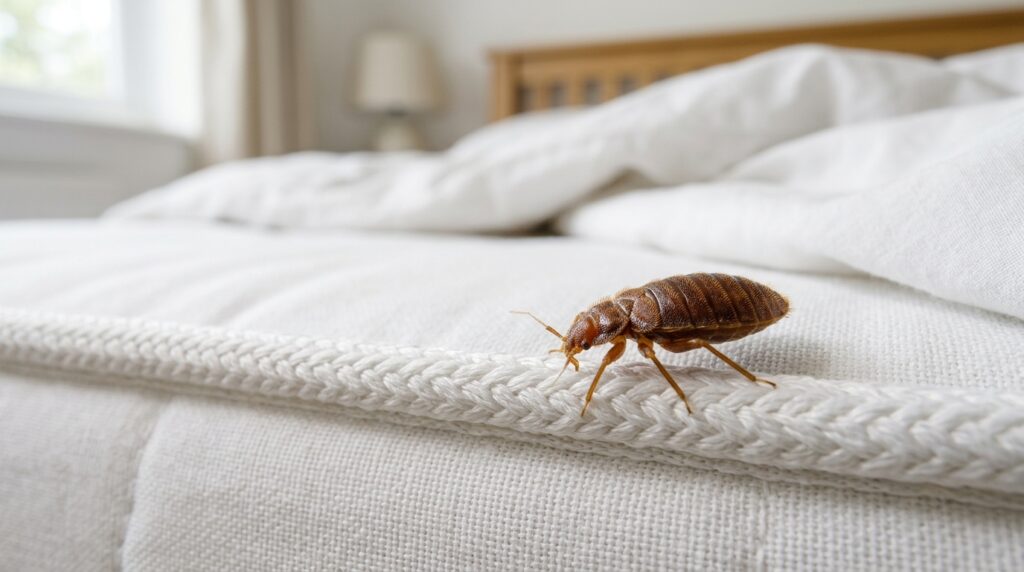
A workplace bed bug problem is not a cleaning problem, and it is not a sign that an office is dirty. Bed bugs arrive in a building the same way they arrive in a home, carried in on bags, coats and clothing, and once they are in an office they settle into the things nobody thinks to look at: the seams of task chairs, soft breakout seating, the underside of desks, skirting and cable trunking. The reason these cases end up in the news is rarely the insect itself. It is that offices are shared, so one unreported sighting on one floor can become a problem for hundreds of people and, eventually, for hundreds of homes.

Key takeaways
- Bed bugs in a workplace are a hitchhiking problem, not a hygiene problem. A spotless office is as exposed as any other, because the insects travel on people and their belongings.
- A deep clean is not a treatment. Cleaning removes debris and reassures people, but it does not reach the harbourage points where bed bugs actually sit, and on its own it can scatter an infestation rather than end it.
- Offices are detected late. Without a sleeping host in the room every night, numbers build slowly and quietly, so by the time anyone reports a bite or a live insect the population is usually older and wider than it looks.
- The real cost is not the office. It is staff carrying bed bugs home, which turns one building problem into many separate household ones.
- One visit never finishes it. Any credible workplace plan covers the whole affected area rather than one desk, and schedules follow-up visits to catch insects emerging from eggs after the first treatment.
What has happened?
Personnel Today reported on 22 September 2026 that employees at The Guardian newspaper have been allowed to work from home during an infestation of bed bugs at its headquarters in London. According to the report, management told staff by email that working from home for the following week was “approved as an exception” for those able to do so in their role, and acknowledged that the situation “might be unsettling for some staff”. The same report says the news production area on the second floor of the building at Kings Place in King’s Cross is understood to be the most affected.
Personnel Today reports that pest control experts were scheduled to carry out a deep clean later that week, with follow-up visits expected afterwards, and that the Guardian chapel of the National Union of Journalists said the union “takes the issue very seriously and is seeking urgent clarification on a number of points”. The report notes that while newspaper staff can work from home, many freelance workers need access to print production software in the office.
We have no involvement in that building and no knowledge of it beyond what has been reported. What makes it worth writing about is that the shape of it is completely ordinary. We see the same pattern in offices, hotels, student halls and care settings across the country, and most of it never reaches a newspaper.
How do bed bugs get into an office?
They are carried in. Bed bugs cannot fly and they do not travel far under their own power, so almost every workplace case starts with an insect or a fertilised female arriving in a bag, a coat, a laptop sleeve, a gym holdall or a piece of second-hand furniture. That is why an office infestation says nothing at all about the cleanliness of the building or the people in it.
What an office then supplies is opportunity. Modern workplaces are unusually good habitat once an insect is inside:
- Upholstered task chairs. Fabric seat pans, stitched seams and the join between the backrest and its frame are among the most reliable places we find bed bugs in a commercial setting.
- Soft breakout furniture. Sofas, pods and banquette seating in kitchens and collaboration areas are rarely moved, rarely inspected underneath, and sit in warm rooms.
- Hot desking. Shared desks and shared chairs mean an insect that arrives with one person can be in contact with a different person the next day, and on a different floor the day after.
- Coat and bag storage. Pooled coats, lockers and under-desk bag hooks put personal belongings in direct contact with each other for hours at a time.
- Clutter and cable runs. Trunking, floor boxes, stacked storage and the backs of pedestal drawers all give the dark, tight harbourage bed bugs prefer.
Why is an office harder to clear than a bedroom?
In a home, bed bugs organise themselves around a sleeping person. That makes them predictable. They harbour within a short distance of the bed, they feed at night, and the evidence turns up in one room, which is why a domestic treatment can be focused and why a professional bed bug treatment has a clear centre of gravity.
An office has no equivalent. People are present in daylight, they move between floors and they do not stay still, so the insects have no single focal point to cluster around. Three things follow from that, and all three make a workplace case harder:
Detection is late. With no reliable nightly host, a workplace population grows more slowly and produces less obvious evidence. There is no mattress to show spotting on and no headboard to check. A bite noticed at home is usually blamed on the home, so the office is often the last place anyone looks.
The affected area is larger than the report. By the time a live insect is seen at one desk, the search area is realistically the whole floor plate and any furniture that has been moved off it, not the desk that was reported. Treating the reported desk alone is the workplace version of treating one flat in a block, which is the single most common reason infestations in shared buildings keep coming back.
Nobody owns the problem at home. An office can be surveyed and treated on a schedule. The homes of the people who work in it cannot, and those homes are where an untreated workplace case quietly reproduces.
Why will a deep clean not fix it on its own?
Across commercial cases generally, cleaning and pest control are different jobs, and conflating them is the most common early mistake. A deep clean addresses what is on the surface. Bed bugs are not on the surface. They sit in seams, joints, voids and fixings, often a few millimetres inside something that looks solid, and they are notably resistant to being dislodged by general cleaning.
There are two practical risks in relying on cleaning alone. The first is false reassurance: the building looks and smells dealt with, the reports stop for a fortnight because the surviving insects are between feeds, and everyone assumes it is over. The second is dispersal. Vigorous cleaning, moving furniture out of a room, and stacking chairs in a corridor all give an established population a reason and a route to move somewhere quieter, which is usually somewhere nobody has looked yet.
Thorough cleaning still has a role. Reducing clutter, emptying floor boxes and vacuuming seams before a treatment genuinely improves the result, because preparation matters more with bed bugs than with almost any other pest. It is the first step of a treatment, not a substitute for one.
What should an employer actually do?
The plan reported in this case, professional treatment with follow-up visits scheduled afterwards, is the right shape. Follow-ups are not an upsell. Bed bug eggs are the reason: insects emerging after the first visit have to be caught by a later one, which is why a single visit closing a workplace case should be treated as a warning sign rather than good news.
Beyond that, the steps that make the difference in a commercial building are these:
- Survey wider than the report. Inspect the full floor plate and anywhere affected furniture has travelled, not just the desk or the chair that was named.
- Tell people early and plainly. Staff who know what to look for produce the reports that define the treatment area. Staff who hear nothing take the problem home without knowing it, and the trust cost of a late disclosure is usually worse than the disclosure.
- Quarantine, do not evict, furniture. Dragging infested chairs and sofas through lifts and corridors to a skip is one of the most reliable ways to seed the rest of a building. Isolate items in place and let the treatment plan decide what goes.
- Give staff a route to report without embarrassment. Bed bugs carry a stigma they do not deserve, and shame is the main reason cases stay hidden until they are large.
- Monitor after the all-clear. Interceptors and follow-up inspections over the weeks after treatment are what turn “no reports” into evidence rather than hope.
- Write it into the pest plan. Most commercial contracts cover rodents and flying insects properly and mention bed bugs barely at all, which is worth checking before you need it rather than after.
We set this out in more detail on our office pest control page, and across the wider commercial pest control service.
What should staff do if their workplace has bed bugs?
The realistic goal is to avoid taking them home, and a small number of habits do most of the work.
- Keep bags and coats off soft furniture and off the floor where you can. A hard surface, a hook or a locker is better than a fabric chair.
- Do not take office cushions, throws or soft items home, and do not take furniture home from a building that is being treated.
- If you think you have been exposed, put the clothes you wore straight into a tumble dryer on a hot cycle when you get home. Heat is what kills bed bugs at every life stage, and a hot dryer cycle is the one genuinely effective thing most households already own.
- Check your own bed for the usual signs, which are small dark spots on the mattress seams and along the base, shed skins, and bites appearing overnight.
- If you do find them at home, do not move to the sofa or a spare room. Bed bugs follow the sleeping person, so changing where you sleep spreads them through the house. Keep sleeping in the same place and get the room treated.
Our bed bug identification and treatment guide covers what the evidence looks like in a home in more detail.
How we handle a workplace case
Our technicians hold RSPH (BPCA) Level 2 qualifications, and a commercial bed bug job starts with a survey of the whole area at risk rather than the point that was reported. Treatment is chosen around the building, because what works in a hotel room is not always what works across an open plan floor with several hundred chairs on it. Heat treatment is often the strongest option for offices, because it treats items in place without taking furniture out through shared corridors, and because it reaches insects at every life stage in one pass. Where a case is caught early and stays localised, a targeted programme with monitoring is usually enough.
We respond 24 hours a day, every day of the year except Christmas Day, and we carry over 27,000 Trustpilot reviews at a rating of 4.7 out of 5. If your building has had a sighting, or you want a bed bug protocol written into a pest plan that does not currently have one, call the number at the top of the page and ask for a commercial survey.
Frequently asked questions
Yes. Bed bugs are carried into workplaces on bags, coats and clothing, and they can then transfer to another person’s belongings from shared chairs, soft seating and storage. It is less common than picking them up from accommodation, and it is not a reflection on how clean the office is, but it does happen and it is the reason workplace cases matter beyond the building itself.
Office chairs are one of the most common places we find them in a commercial setting, particularly in the seams of the seat pan and where the backrest meets its frame. Carpet itself is a poor harbourage, but the edges matter: bed bugs use the gap under skirting, carpet grippers at the perimeter of a room, and cable trunking and floor boxes, all of which are dark, tight and undisturbed.
Keep bags and coats off upholstered furniture, do not bring soft items or furniture home from a building being treated, and if you think you have been exposed, put the clothes you were wearing through a hot tumble dryer cycle as soon as you get home. Then check your own bed for dark spotting along the mattress seams over the following weeks, because evidence at home can take time to appear.
It depends on how long the infestation has been established and how much of the floor is involved, but it is measured in visits rather than in a single appointment. Eggs are the reason: insects hatching after the first treatment have to be caught by a follow-up, so any workplace plan should include return visits and a period of monitoring before anyone calls it finished.