
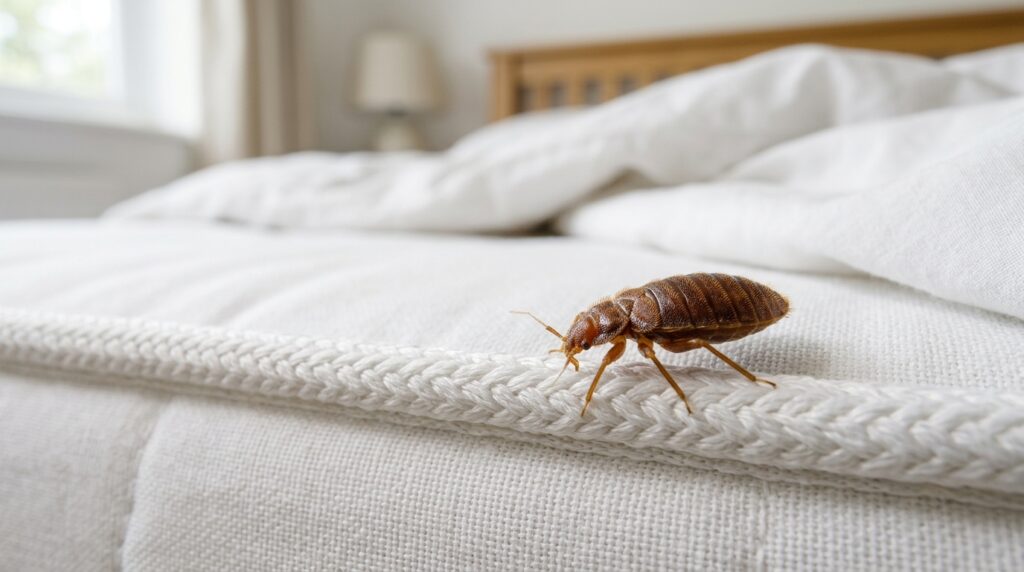
Bed bugs in a block of flats are a building problem, not a flat problem. In a house, an infestation is contained by the walls around it. In a block, the same insect has routes that a single household cannot close: service voids and pipe runs between adjoining flats, communal corridors, lifts and bin stores, and furniture being dragged through those shared spaces on its way out. That is why treating flats one at a time, in the order they were reported, tends to move an outbreak around a building rather than end it, and why the most useful thing a resident can do while waiting is often the opposite of what instinct suggests.

Key takeaways
- Bed bugs are not a sign of a dirty home. They are carried in on clothing, luggage and second-hand furniture, and a spotless flat is as vulnerable as any other.
- In a block, treating one flat at a time is the main reason outbreaks persist. A cleared flat next to an untreated one gets reinfested, so treatment needs to cover the affected flat and everything adjoining it on the same visit.
- Throwing out beds and sofas rarely solves it, because in an established infestation a large part of the population is harbouring in the room rather than in the furniture, and moving infested items through communal areas is how the rest of the building gets seeded.
- Moving to sleep on a sofa or in a spare room is one of the fastest ways to spread bed bugs through your own home, because they follow the sleeping human.
- Preparation matters more with bed bugs than with almost any other pest. A treatment applied to an unprepared, cluttered flat is starting at a disadvantage no product can make up.
What has happened in Bristol?
Bristol Live reported on 11 September 2026 that residents of three council tower blocks in Hartcliffe, south Bristol, are dealing with a bed bug infestation affecting dozens of residents. According to the report, the three blocks contain around 60 homes each, housing hundreds of residents, and the problem became serious more than a month ago at the height of the heatwave.
One resident, who the paper said did not want to be named, described having to throw away two bedrooms worth of beds, mattresses and soft furnishings, and said he had seen at least 20 beds, mattresses and sofa beds put out by other residents in his block alone. Residents told Bristol Live that they had been contacting the local authority’s pest control service and housing officers, and had been told there was a waiting list for individual flats.
The local authority told the paper it was aware of reports of bed bugs in some of its apartments in the Hartcliffe area, that reports are referred to a specialist contractor who assesses each property before deciding on treatment, and that each case is being considered individually because of the type of property involved. Notices put up in the blocks tell residents that bed bugs are not a sign of a dirty home, that they spread by hitchhiking on clothing, bedding and furniture, and that anything being disposed of should be wrapped, bagged and sealed rather than left on landings, in lift lobbies or in bin stores.
We are not going to second-guess how any particular building is being managed from the outside. What is worth doing is explaining why outbreaks in blocks behave differently from outbreaks in houses, because that is the part that is genuinely counter-intuitive, and it is the same in council housing, housing association stock, private blocks and student accommodation.
How do bed bugs move between flats?
There are three routes, and they matter in roughly this order.
Through the structure. Adjoining flats are rarely sealed from one another. Bed bugs are flat enough to use gaps most people would not call gaps: the space behind a socket or light switch back box, the hole where a waste pipe or heating pipe passes through a wall or floor, the gap behind coving and skirting, and the voids around riser cupboards and service shafts that run vertically through a building. Movement through these routes is usually short-range, so the flats most at risk from any one infested flat are the ones directly next door, directly above and directly below.
Through communal areas, on objects. This is the route that turns a problem in a few flats into a problem in a building. An infested mattress or sofa dragged unwrapped along a corridor, into a lift and down to a bin store leaves insects and eggs along the whole path. The next resident to carry a laundry basket or a cardboard box along that route can pick them up. It is the reason the advice about bagging and sealing discarded furniture is not bureaucratic box-ticking, and it is the single piece of communal guidance most worth following.
On people. Bed bugs do not live on the body the way head lice do, but they are readily carried on clothing, bags and bedding. Visiting a neighbour, using a shared laundry, or helping someone move a bed is enough.
Understanding the order of those routes explains something residents often find baffling: why a flat that has never had a second-hand item brought into it, in a household that keeps it immaculate, can still end up infested.
Why does treating one flat at a time not work?
This is the central problem in any block, and it is arithmetic rather than opinion.
Suppose flat A is reported, surveyed and treated properly. If the flat next door has an established population that nobody has reported, because the residents have not connected their bites to bed bugs, or are embarrassed, or are simply not being bitten much yet, then insects continue moving into flat A through the structure. Within a few weeks flat A has bed bugs again. The resident concludes that the treatment failed. The next treatment goes to the back of the queue. Meanwhile the untreated flat has been breeding throughout.
A queue that works through reported flats in the order they were reported will always be behind the outbreak, because reporting lags infestation by weeks or months. The approach that works is to treat in clusters. When a flat is confirmed, the flats immediately adjoining it, above, below and either side, are surveyed at the same time and treated together where there is any evidence, whether or not those residents have complained. That is more work upfront and considerably less work overall, because it removes the source of reinfestation instead of repeatedly clearing the symptom.
The same logic applies to surveying. A block-level inspection that looks at a sample of flats along each affected route tells you the actual extent of an outbreak. Waiting for reports tells you where people have noticed, which is a different and much smaller map.
Should you throw out your bed and your sofa?
Usually not, and in a block it can actively make things worse.
The instinct is completely understandable. When you find bed bugs in a mattress the mattress feels like the problem, and getting it out of the flat feels like taking action. In practice, by the time an infestation is established the insects are not confined to the bed. They harbour in the bed frame joints and slats, behind the headboard, in the seams of the divan base, under carpet edges and skirting, behind sockets and switch plates, in curtain hems, behind picture frames and in bedside furniture. Removing the mattress removes a fraction of the population and leaves the rest in place, with a new mattress arriving as a fresh feeding site.
There are three further problems specific to a block. Moving an unwrapped item through shared corridors spreads the infestation into the building. Items left in communal areas can be taken by other residents, which relocates the problem into another home. And a room stripped of furniture is harder to treat well, not easier, because the harbourage that remains is now spread more thinly around the room and the obvious targets have gone.
Where furniture genuinely is beyond saving, and sometimes it is, the right sequence is to bag and seal it inside the flat before it moves anywhere, mark it clearly as infested, and get it out of the building rather than leaving it in a shared space. That is exactly what the notices in the Bristol blocks are asking for, and on that point the guidance is sound.
What should you do while you are waiting for treatment?
These are the measures that hold a population back and make the eventual treatment more effective.
- Keep sleeping in your own bed. This is the advice people find hardest to accept and it is the most important one on the list. Bed bugs orient towards a sleeping human, so moving to a sofa, a spare room or a relative’s house takes the infestation with you and establishes it in a second location. If you have already moved, tell whoever treats the flat, because the room you moved into now needs including.
- Use interceptors under the bed legs. Simple cups that a bed bug can climb into but not out of will both monitor the population and cut off the route up the legs, provided the bed is moved away from the wall and the bedding is not touching the floor.
- Hot wash and tumble dry fabrics. Heat is what kills them. A hot tumble dry cycle is the reliable step, and it works for items that cannot be hot washed. Bag laundry inside the flat before carrying it anywhere, and do not put clean items back into an untreated wardrobe.
- Fit encasements on the mattress and base rather than replacing them. These trap what is inside and make the surface easy to inspect.
- Reduce clutter, do not redistribute it. Clearing the floor and the space under the bed helps treatment reach harbourage. Moving boxes and bags into another room to achieve it does not.
- Report it, and encourage neighbours to. Unreported flats are what keeps a block outbreak running, and that is far more often embarrassment than indifference. Bed bugs carry a stigma they do not deserve.
- Do not use foggers or bug bombs. They do not penetrate harbourage, and their main effect is to disperse insects further into wall voids and adjoining rooms, which in a block means towards the neighbours.
What should landlords and housing providers take from this?
Three things, all of which cost less than repeated single-flat callouts.
Survey the cluster, not the complaint. Every confirmed flat should trigger an inspection of the flats adjoining it in all directions. Treat in blocks so that reinfestation between neighbouring flats is designed out instead of waited for.
Control the communal route actively. Bagging guidance on a notice board only works if there is somewhere practical to put a sealed item and it is removed quickly. A sealed mattress standing in a lift lobby for a week is still in the building.
Communicate early and without blame. The message that bed bugs are not caused by poor housekeeping is not just reassurance, it is what gets flats reported while an infestation is still small. Buildings that handle this well see reports come in earlier, which is the single biggest factor in how long an outbreak lasts.
The underlying pressure is not going away. Bed bug activity in the UK has been rising for several years, as we covered when the latest figures were published in our analysis of the 44 per cent rise in bed bug activity. Shared buildings are where that trend shows up first, which is also why bed bugs in student accommodation follow much the same pattern each autumn.
When is it worth getting a professional in?
Bed bugs are one of the few pests where do-it-yourself treatment rarely works, and where a failed attempt makes the professional job harder, because scattered insects and partial exposure to insecticide push the population deeper into voids.
Get a survey when you have confirmed bed bugs or bites you cannot account for, when treatment has already been tried and they have come back, or when you live in a flat and suspect the source may not be your own home. In a shared building it is worth speaking to whoever manages the block as well, because the flat next door matters as much as yours. We have set out what a proper treatment involves in how professionals get rid of bed bugs.
Our technicians attend every day of the year except Christmas Day, and you can book online or on web chat at any time, day or night. If you are dealing with bed bugs in a flat or a whole building, call the number at the top of the page and we will arrange a survey. You can read more about our bed bug treatment service, and about commercial and managed property pest control if you are responsible for a block.
Frequently asked questions
Yes. They move through the gaps around pipe runs, socket and switch back boxes, skirting, coving and service voids, which is why the flats most at risk are those directly next door, above and below an infested one. They are also carried between flats on clothing, bedding and furniture moved through communal corridors, lifts and bin stores.
No. Bed bugs feed on blood, not on food waste or mess, so cleanliness has almost no bearing on whether a home gets them. They arrive on luggage, clothing, second-hand furniture or from an adjoining property. Clutter makes an infestation harder to treat because it provides more harbourage, but it does not cause one.
The usual reason is an untreated neighbouring flat. If insects are still moving in through the structure from next door, above or below, a correctly treated flat will be reinfested within weeks and it will look as though the treatment failed. This is why affected flats and those adjoining them should be surveyed and treated together rather than one at a time.
In most cases no. By the time an infestation is noticed, insects are also harbouring in the bed frame, behind the headboard, in skirting, behind sockets and in nearby furniture, so removing the mattress leaves most of the population in place. A mattress encasement usually achieves more. If an item genuinely has to go, bag and seal it inside the room before moving it, and get it out of the building rather than leaving it in a communal area.