
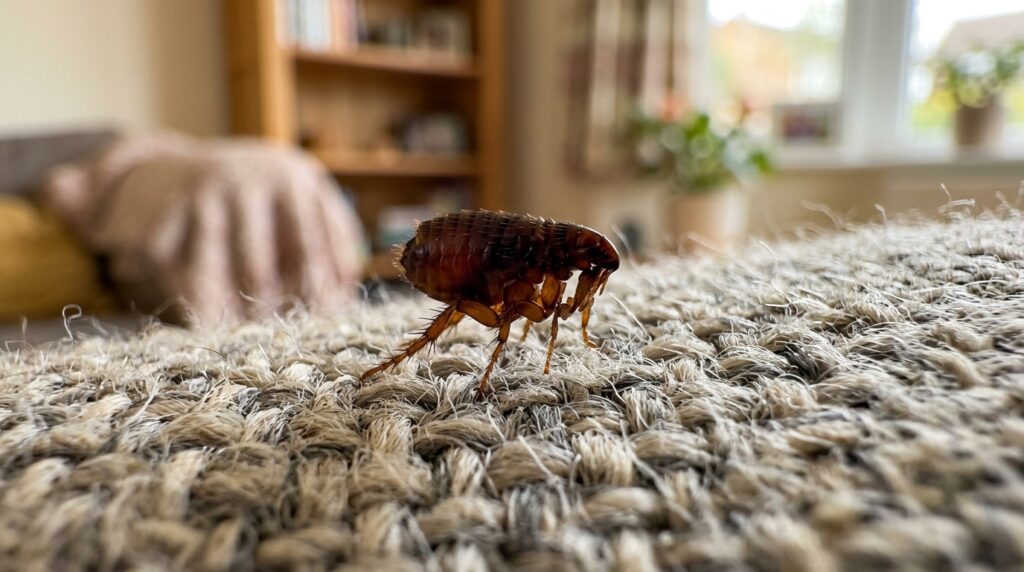
A survey commissioned by the National Office of Animal Health (NOAH) has found that one in five cat owners and one in ten dog owners in Great Britain say their pet has had fleas in the past year, Companion Life reported on 4 November 2026. If your pet has had fleas, the bigger job is usually the house rather than the animal. Here is what the figures say, and what to do if fleas have reached your carpets and furniture.

Key takeaways
- According to the NOAH survey, one in five cat owners and one in ten dog owners in Great Britain say their pet had fleas in the past year.
- Around a third of cat owners and a quarter of dog owners said they do not proactively treat their pets for fleas.
- The PDSA estimates around 95% of a flea problem lives in the home rather than on the pet, so treating the animal alone rarely ends it.
- Pet treatment is a job for your vet, an SQP or another suitably qualified adviser. The home is where a pest controller comes in.
- Get advice on every pet in the household from your vet or adviser, and treat the home at the same time, otherwise fleas can come back from whichever part was missed.
What did the NOAH flea survey find?
The headline figure is that one in five cat owners and one in ten dog owners across Great Britain said their pet had fleas in the past year. Around two-thirds of pet owners said they were concerned about fleas, yet around a third of cat owners and a quarter of dog owners said they do not proactively treat their pets for them.
The survey also found big differences between groups. More than a third (37%) of cat owners aged 18 to 24 reported that their cat had fleas in the last year, the highest proportion of any age group. Among dog owners in the same age group the figure was 19%. By region, a third (33%) of cat owners in the West Midlands said their cat had fleas in the last year, and among dog owners those in London were the most likely to report fleas, at 15%.
Why is the house the bigger problem than the pet?
Companion Life cites the PDSA’s estimate that around 95% of a “flea problem” lives in the home rather than on the pet. That matches what our technicians see. Adult fleas feed on the animal, but the eggs drop off wherever the pet walks, sleeps and sits, and the young stages develop in carpets, rugs, sofas, pet bedding and the gaps along skirting boards and floorboards.
That is why, in our experience, a household can treat the cat, see the scratching stop for a while, and then find fleas again weeks later. The next generation was already waiting in the furnishings. Companion Life notes that once an infestation takes hold, fleas can spread throughout the home, and that in some cases they bite people as well as pets.
Can you get fleas in winter?
Yes. Many people think of fleas as a summer problem, and the peak does tend to come in late summer. In our experience, though, a centrally heated home stays warm enough for fleas to keep developing indoors right through the colder months, so a problem that starts in autumn does not simply die off when the weather turns. If your pet has had fleas this year and the house was never treated, it is worth checking now rather than waiting for spring.
What should you do if your pet has had fleas?
NOAH says there is no one-size-fits-all approach to parasite protection, and encourages owners to think about their own pet’s risk and speak to their vet, SQP or another suitably qualified adviser about the right approach for their animal. That advice covers the pet. For the home, these are the steps we recommend:
- Ask your vet or SQP about every animal in the household. If you have a cat and a dog, or more than one cat, treating only the one that is scratching can leave the others carrying fleas.
- Vacuum thoroughly and often. Cover carpets, rugs, sofas, under furniture and along skirting boards, and empty the vacuum outside afterwards.
- Wash pet bedding and throws on a hot wash. Include blankets or cushions your pet likes to lie on.
- Watch for bites on people. Small itchy bites around the ankles and lower legs are a common sign that fleas are in the carpets. Our guide to telling flea bites from bed bug bites can help.
- Get the home professionally treated if fleas keep coming back. A professional treatment targets the places the young stages develop, which household sprays often miss.
We cover the full pet and property approach in our guide to treating pets and the property together.
How JG Pest Control can help
Our flea control service treats the home, working alongside whatever treatment your vet or adviser recommends for your pets. Our technicians hold the RSPH (BPCA) Level 2 Award, and trainees work alongside qualified colleagues. We will tell you how to prepare the house before the visit and what to do afterwards. We respond within 24 hours every day of the year except Christmas Day. To arrange a visit, call the number at the top of the page or use the enquiry form.
Frequently asked questions
According to a survey commissioned by NOAH and reported by Companion Life on 4 November 2026, one in five cat owners and one in ten dog owners in Great Britain said their pet had fleas in the past year. The figure was highest among owners aged 18 to 24: 37% of cat owners in that age group reported that their cat had fleas in the last year.
Not necessarily. The PDSA estimates that around 95% of a flea problem lives in the home rather than on the pet. In our experience, treating the pet without treating carpets, furniture and bedding often leads to fleas coming back as the young stages in the home develop.
Yes, for a time. In our experience fleas left behind in a home, for example after a previous occupant’s pet has gone, can still bite people. If you have moved into a property and are getting bites, it is worth having it checked.
NOAH encourages owners to speak to their vet, SQP or another suitably qualified adviser about the right flea protection for their animal. A professional pest control company treats the home. For the best result, both should happen at the same time.