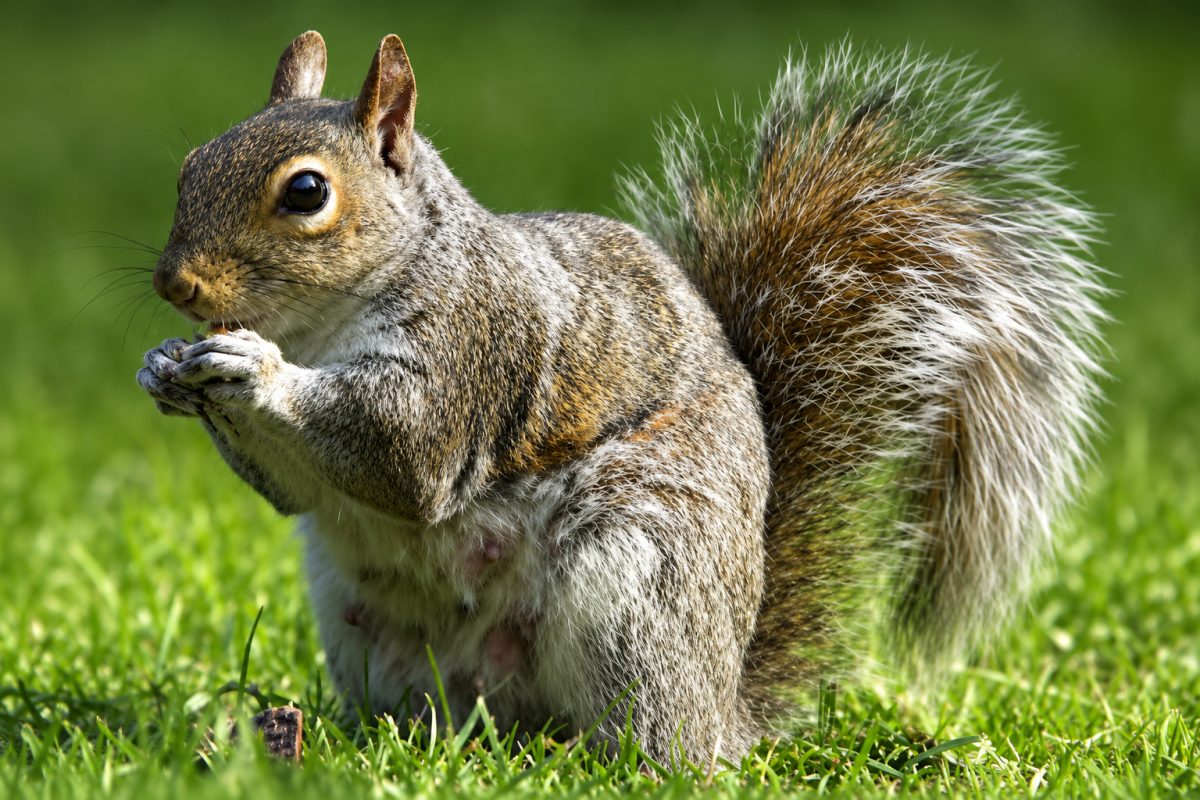
Grey squirrels in a loft are the most damaging single pest most UK homeowners will ever face. They gnaw structural timber, strip insulation, chew through electrical cabling (with a recognised fire risk), and they breed twice a year. JG Pest Control treat squirrel infestations across the whole of the UK, with same-day cover in major cities, 24-hour response across mainland Britain, and every job carried out by a BPCA Level 2 Certified Technician.
This is the JG hub for squirrel problems in the UK. It covers identification, the legal framework (greys are an invasive non-native species, reds are fully protected, the rules are strict and we follow them), why DIY rarely solves the issue, and what we do to clear an infestation and proof the loft. For a free phone quote, call 0330 053 9002 .

LEGAL, EFFECTIVE SQUIRREL CONTROL, GUARANTEED.
About Squirrels in the UK
The UK has two squirrel species. The grey squirrel (Sciurus carolinensis) is the invasive North American species introduced in the late 1800s, now present across almost the whole of mainland Britain at high density and responsible for essentially all UK squirrel pest calls. Adults are 25 to 30 cm body length, with a brush of 19 to 25 cm, weighing 400 to 700 g. Coats are grey-brown with white underparts.
The red squirrel (Sciurus vulgaris) is the native UK species, now confined to specific reserves and refugia (Scottish Highlands, Northumberland, the Isle of Wight, Anglesey, the Lake District). Red squirrels are fully protected under the Wildlife and Countryside Act 1981. JG will never treat a red squirrel, and the species identification step at the survey is critical.
A grey squirrel produces two litters a year, typically in February to April and again in July to August, of 2 to 5 kits per litter. The species is well-adapted to UK lofts and roof voids, where it gnaws an entry point through soffit, fascia, eaves felt or vent, and uses the loft as a winter shelter or breeding site. Activity inside the property is mostly during daylight, with peak noise in the early morning.
Squirrel Quick Facts
- Grey squirrel: 25 to 30 cm, grey-brown coat
- Red squirrel: smaller, russet, ear tufts, fully protected
- Two litters a year: spring and summer
- Diurnal, peak loft noise in the early morning
- Gnaws electrical cabling (fire risk)
- Greys are a Schedule 9 invasive species: release is illegal
Suspect squirrels in the loft? For BPCA Level 2 Certified squirrel control, call 0330 053 9002
Why Squirrels in a Loft are a Serious Problem
Squirrels in a loft are a different problem from squirrels in the garden. The structural and fire risk is real, and loss adjuster data routinely attributes UK domestic fires to chewed loft cabling, often with squirrel activity as the proximate cause.
The damage comes in three forms. First, gnawing. Like rats, squirrel incisors grow continuously and require constant gnawing. Loft cabling, water pipework, structural timber and stored items are all routinely damaged. Second, nest building. A breeding female strips and shreds insulation to build a drey, which destroys the thermal performance of the loft and creates a fouled, urine-soaked area that has to be removed and replaced. Third, noise and disturbance. Daytime running and gnawing in the loft directly above a bedroom is disruptive enough to cause genuine sleep and stress problems.
The legal framework is important. Grey squirrels are listed under Schedule 9 of the Wildlife and Countryside Act 1981 as a non-native invasive species: it is illegal to release a captured grey squirrel back into the wild, and live-trapped greys must be humanely dispatched. This rules out the “catch and release” approach that some homeowners default to. Red squirrels are fully protected and must never be trapped or killed. Professional control turns on first being absolutely certain of the species (in practice, almost certainly grey if you are inside a UK city or lowland England), then applying a legal trapping protocol.
For landlords, persistent squirrel activity in a roof void is a fitness-for-habitation matter under the Homes (Fitness for Human Habitation) Act 2018, particularly where damage to cabling creates fire risk. JG provide written treatment reports suitable for those records.
Signs of an Infestation
- Loud running, scratching or gnawing in the loft, mainly early morning
- Visible gnaw point on soffit, fascia, eaves felt or vent
- Loft insulation disturbed, shredded or compacted into a drey
- Droppings (8 to 12 mm, oval, dark) in loft insulation
- Stripped bark on garden trees (a strong nearby-population indicator)
- Chewed plastic pipework or cable insulation
- Cached nuts and seeds in lofts and outbuildings
Professional vs DIY: Why Live Traps and Ultrasonics Don’t Solve It
The two most common DIY squirrel responses (a humane live trap and an ultrasonic deterrent in the loft) both fail to address the problem and, in the case of the live trap, can put the homeowner in breach of the Wildlife and Countryside Act 1981 if a trapped grey is then released.
Ultrasonic deterrents have repeatedly failed independent testing on commensal mammals and there is no good evidence they remove an established loft population. Live trapping is technically simple but the release step is illegal for greys, and trapping without immediate humane dispatch raises an Animal Welfare Act issue. Most DIY attempts end with a homeowner who has caught one squirrel, does not know what to do with it, and still has the rest of the family in the loft.
Professional squirrel control is a survey, a kill-trap protocol carried out in compliance with the law, and a proofing job to close the entry point. The kill-trap step uses spring-traps to the AIHTS standard, placed inside the loft on professional run-set positions and checked every 24 hours. The proofing step seals the entry point with heavy-gauge metal mesh and timber repair, because an unproofed loft will be re-colonised within weeks of being cleared.
What JG Will Do
- Species identification (grey vs red, critical)
- Loft and roof exterior survey to find entry points
- AIHTS-standard kill-trap protocol
- Daily trap checks until activity stops
- Permanent proofing of entry points
- Insulation clearance where heavily fouled
- Written report and guarantee
For BPCA Level 2 Certified squirrel control, call JG Pest Control on 0330 053 9002
Our Squirrel Treatment Process
- Phone call. A free 5 to 10 minute call to confirm the likely species (grey vs red), the type of activity (loft, garden, both), and book a survey. Most domestic squirrel jobs are priced as a package on the phone.
- Survey visit. A BPCA Level 2 Certified Technician inspects the loft and the external roofline, confirms species, identifies the entry point and any secondary entry routes, and assesses insulation damage.
- Trapping protocol. AIHTS-standard spring-traps placed inside the loft on professional run-set positions, baited and tunnelled to prevent non-target catches. Traps are checked every 24 hours until activity ceases (usually 5 to 10 days for a single-property infestation).
- Proofing. Heavy-gauge metal mesh or steel sheet to the entry point and any other vulnerable points on the roofline. Permanent timber and felt repair where needed. Mesh skirting to obvious access points (climbing trees overhanging the roof).
- Insulation clearance. Where the loft drey has fouled the insulation, the damaged area is removed and the loft is cleaned. Replacement insulation is quoted separately.
- Guarantee. Every treatment is fully guaranteed in writing. The proofing carries a 5-year guarantee against re-entry, the trapping carries a 12-month guarantee against the original infestation returning.
Related Services and Local Coverage
JG run squirrel treatments across the entire UK, with same-day cover available in major cities and a 24-hour response everywhere else.
Related services:
City coverage examples:
- Pest control in London
- Pest control in Essex
- Pest control in Manchester
- Pest control in Sheffield
- Pest control in Newcastle
- Pest control in Bristol
Not listed? Call 0330 053 9002 . We cover mainland UK and can usually be on site within 24 hours.

Trusted by 23,000+ Trustpilot reviewers, rated 4.8 out of 5. BPCA Level 2 Certified Technicians on every job.
Open early, late, every weekend, every bank holiday (except Christmas Day). Call 0330 053 9002
Recent Squirrel Work
- Domestic loft squirrel removal and proofing
- Garage and outbuilding squirrel exclusion
- Insulation clearance and replacement on heavily fouled lofts
- HMOs with shared roof void squirrel issues
- Schools, nurseries and church loft jobs
- Listed buildings (with planning compliant proofing)
Why Choose JG Pest Control
- Same-day or 24-hour response across mainland UK
- Open every weekend and every bank holiday except Christmas Day
- BPCA Level 2 Certified Technicians on every job
- Strict Wildlife and Countryside Act 1981 compliance
- AIHTS-standard humane trapping
- 5-year guarantee on installed proofing fabric
- Trusted by 23,000+ Trustpilot reviewers, rated 4.8 out of 5
- Founded in 2010, 15+ years of UK squirrel work
Frequently Asked Questions: Squirrels
How quickly can you get to me?
Same-day cover is standard across London, Manchester, Sheffield, Bristol, Newcastle and Essex. Anywhere else in mainland UK we aim to be on site within 24 hours. Out of hours our national line on 0330 053 9002 rolls 24/7.
Are you available weekends and bank holidays?
Yes. JG Pest Control is open every weekend, every bank holiday except Christmas Day, with the phone line staffed early in the morning through to late in the evening. Loft squirrels are usually picked up at weekends when people are at home, and we keep cover open for that reason.
Can I just live-trap and release the squirrel?
No. Grey squirrels are listed under Schedule 9 of the Wildlife and Countryside Act 1981 as an invasive non-native species, and it is illegal to release a trapped grey squirrel back into the wild. Live-trapped greys must be humanely dispatched. This is one of the most common reasons we are called: a homeowner has caught one squirrel, cannot release it, and does not know what to do next.
Will the treatment harm pets or children?
Spring traps are placed inside the loft, in tunnels that prevent non-target catches, and well out of reach of any pet or child. There is no use of poison in squirrel control: rodenticide is not approved for squirrel use in the UK.
Do I need to leave the property?
No. Squirrel treatment is done in the loft and on the exterior of the roof. Occupants stay in the property as normal.
How much does squirrel control cost?
Most domestic squirrel jobs are a fixed package price for survey, trapping, sign-off and basic proofing, agreed up front after the phone diagnosis. Complex jobs (extensive roofline proofing, insulation replacement) are priced after the survey. Call 0330 053 9002 .
How long until the squirrels are gone?
Most single-property loft jobs are resolved within 5 to 10 days of trap installation. Larger or recurring jobs take longer. We do not sign off until activity has stopped and the entry point is proofed.
Will more squirrels come back after this lot are removed?
Only if the entry point is not proofed. The most important step is closing the entry route with heavy-gauge mesh or steel sheet, otherwise the loft is rented out to the next breeding female within weeks. This is why proofing is a non-negotiable part of every JG squirrel job.
Are your technicians qualified?
Every job is carried out by a BPCA Level 2 Certified Technician, the recognised UK industry qualification for pest management. JG Pest Control was founded in 2010 and has been treating squirrel infestations across the UK for more than 15 years.
For same-day squirrel control and a free phone quote, call JG Pest Control on 0330 053 9002