The feral pigeon is the bird we are called to more than all other species combined. It is a cliff-nesting bird that has adapted perfectly to buildings: ledges read as cliff faces, parapets and roof valleys read as sheltered nesting sites, and a solar array reads as a warm, dry, enclosed cavity. Once a flock has settled it will not move on by itself, because the building is doing exactly what the birds need.
That is why pigeon work is a proofing job rather than a removal job. Clear the birds without closing the roost and a new flock occupies it within weeks. Our surveys start by identifying where the birds are actually sitting, nesting and entering, and the specification follows from that.
We work on domestic roofs and balconies, commercial premises, food and retail sites, warehouses, car parks and listed buildings, anywhere on the UK mainland. Call the bird team on 0330 053 9002.
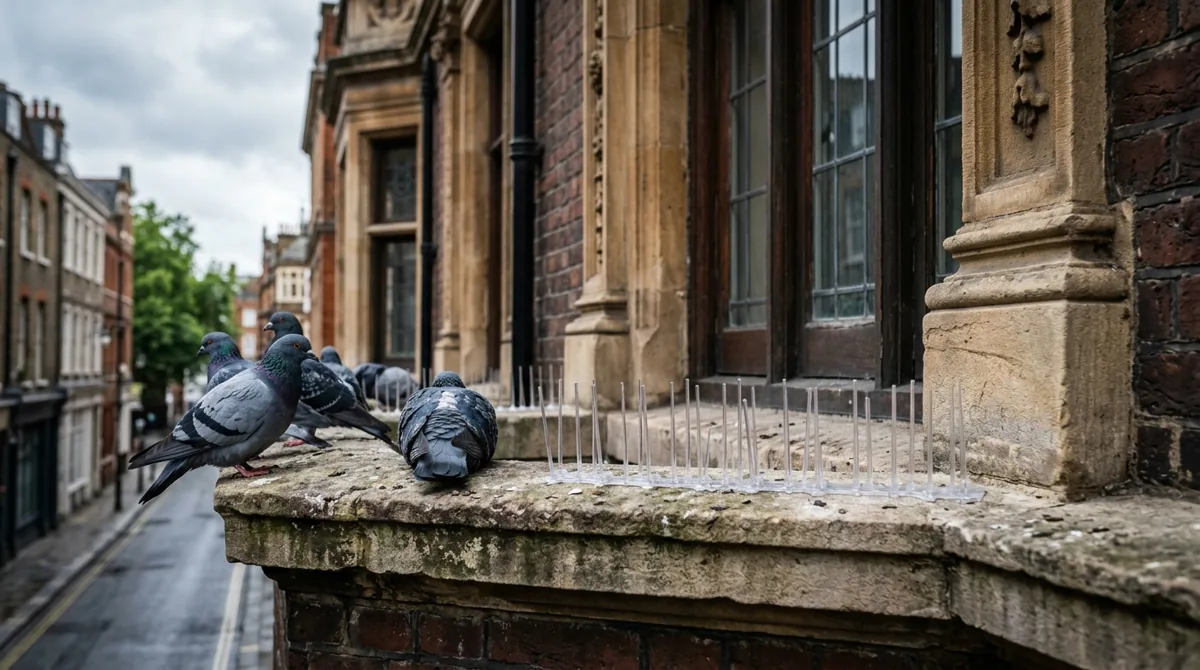
Anti-bird spikes fitted along part of a ledge where pigeons roost.
Birds sitting in the same spot dailyA consistent roosting line on a ledge, parapet or ridge is the clearest early sign, usually before any nest appears.
Droppings streaking the elevationVertical staining down a wall, signage or window directly under a ledge marks an established roost.
Cooing and scratching overheadNoise from a roof void, soffit or the cavity under a solar array, most obvious at first light.
Feathers and nest material in guttersTwigs and feathers washing into hoppers and downpipes, often the first thing a facilities team notices.
Blocked or overflowing drainageNesting material backing water up under the roof covering, which turns a bird problem into a water ingress problem.
Mites appearing indoorsBird mites moving into rooms below after a nest above the ceiling is abandoned.
How We Proof Against Pigeons
Netting across courtyards, elevations, canopies and internal voids
Stainless steel post and wire along ledges, parapets and signage
Spikes where the ledge profile genuinely suits them, not as a default
Mesh skirting and clips to close the cavity under solar panels
Proofing to soffits, vents and gaps that give access to a roof void
Full written specification before any work begins
Clearance and Aftercare
Nest removal once the nest is legally clear to remove
Guano removal and disinfection, including loft and roof void decontamination
Bird mite treatment where a nest has been in a ceiling or void
Gutter and hopper clearance where nesting material has blocked drainage
Documented treatment record on completion
Pigeon Guano and Why It Matters
Guano is not just unsightly. It is acidic, so left on a roof covering, render, stonework or a vehicle it etches the surface, and on a walkway or flat roof it becomes genuinely slippery when wet. Accumulations in a loft or roof void also hold moisture against the timber.
There is a health dimension as well, which is why clearance is a specialist job rather than a broom and a bin bag. Dried droppings can be disturbed into airborne dust, and accumulations support bird mites which readily migrate into occupied rooms once the nest is abandoned. Our clearance work is done with appropriate protective equipment and disinfection, and the waste is removed rather than swept aside.
The point we would make to any building owner is that clearance without proofing is money spent twice. Once the guano is gone, the roost is still there and still attractive. Every clearance we quote is paired with the proofing needed to stop it recurring.
By removing the roost, not the birds. Pigeons return to a building because its ledges, voids and cavities suit them, so the permanent fix is physical exclusion: netting, post and wire, or mesh that closes the space they are using. Clearing birds or nests without proofing gives you a few quiet weeks before a new flock takes the same spot. A correctly specified proofing install lasts years.
While a nest is in use or being built it is protected under the Wildlife and Countryside Act 1981, along with the birds and their eggs, so it cannot simply be removed because it is in the way. Once a nest is genuinely no longer in use it can be removed and the site proofed. We will tell you where you stand on your building and, if the work has to wait, when in the season it can be done.
On the right ledge, yes. On the wrong one they can make things worse, because birds will nest between poorly specified spikes and the spikes then hold the nesting material in place. Spikes suit narrow ledges with a clear profile. Wider ledges, parapets and anywhere birds are nesting rather than perching usually need post and wire or netting instead. That judgement is what the survey is for.
They damage the installation rather than the panels themselves. Pigeons nest in the warm cavity between the array and the roof, packing dry nesting material against live DC cabling, and their droppings on the panel glass reduce output. We close the cavity with a mesh skirt fixed by clips to the panel frame, with nothing drilled or glued to the array, so the manufacturer warranty is unaffected.
It should be treated as a biohazard and cleared properly rather than swept. Dried droppings can be disturbed into airborne dust, accumulations support bird mites that migrate indoors once a nest is abandoned, and the guano itself is acidic enough to damage roof coverings, stonework and paintwork. Clearance should be done with appropriate protective equipment and disinfection, and paired with proofing so it does not build up again.
Same day cover is standard across London and our main regional areas, with a typical 24 hour response elsewhere on the mainland. Most pigeon jobs run as a survey followed by a booked install, because the proofing has to be specified to the building. We are open every day of the year except Christmas Day. Call 0330 053 9002 to get the survey booked.
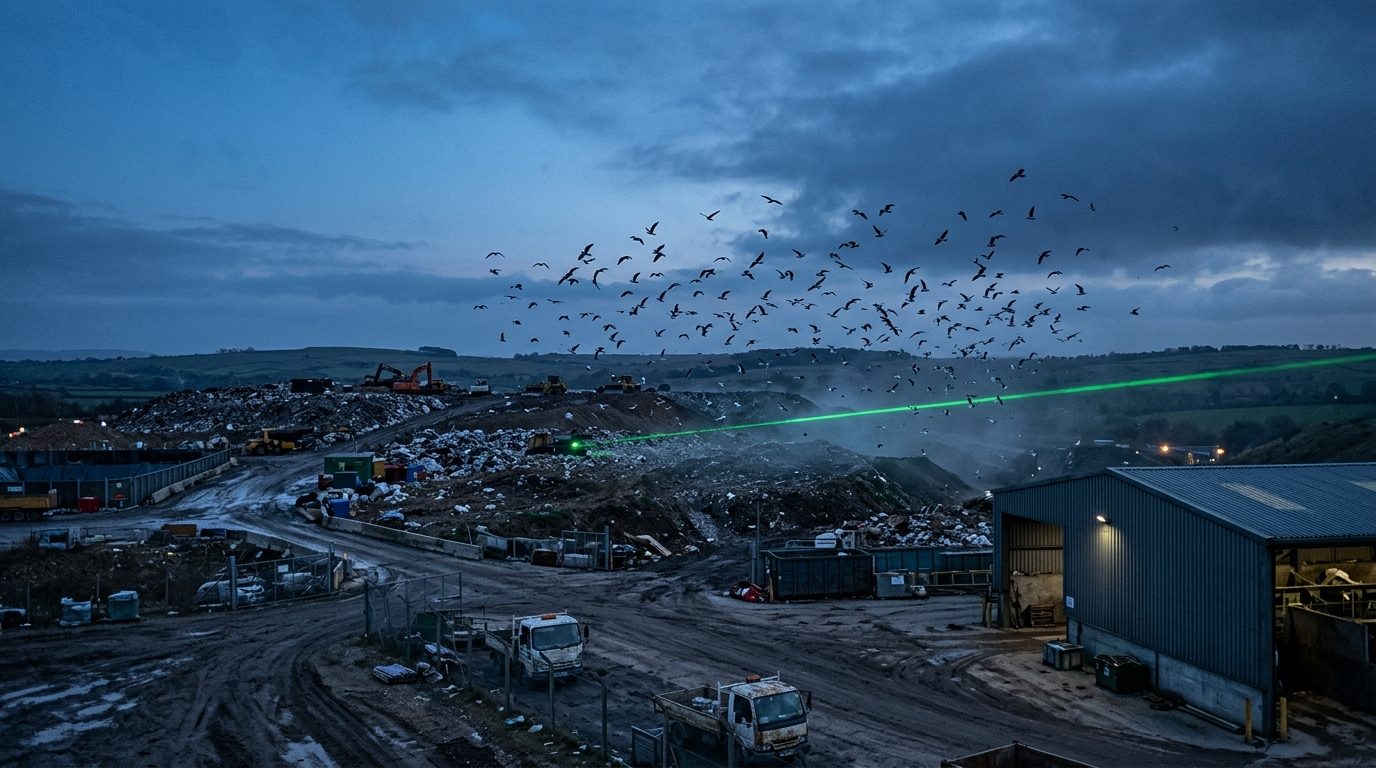
Too big to net? Disperse instead
Two systems that clear birds off ground far too large to proof. We survey, install, commission and service both.
Laser
BirdZout
Silent, so it works where nothing else can.
No noise, no complaints, no planning argument. A moving green beam clears open ground at dawn and dusk, and birds never learn to ignore it.
Roy Couch is the Technician Manager at JG Pest Control, leading the technician team across the UK. He holds the BPCA Diploma and the RSPH Level 2 Award in the Safe Use of Aluminium Phosphide, and is qualified in the Safe Use of Rodenticides.
Peter Bowers-Davis is a board volunteer at the British Pest Control Association (BPCA), the UK trade body for professional pest management. He works across the Tyro UK group of companies, including JG, setting technical standards, treatment protocols and training programmes.
Real reviews left on Trustpilot by JG Pest Control customers who mention bird control.
★★★★★
Pigeon nest in the loft
Steve and his colleague dealt with the problem in a through and professional way. Keeping me informed at all times, throughout the process. Finishing the job on the day, as they promised.
★★★★★
Responsive and organised
Jay and his colleague attended on time to address my pigeon pest problem. They were personable and efficient and my back terrace is now looking much better!
★★★★★
Mischief managed! Paul did a super job with an unwelcome visitor in our chimney – safely and carefully removing the pigeon. Would recommend! (Paul, not the pigeon)
★★★★★
Pigeon Problem Sorted
Big thank you to Ryan & Matt for their help with my pigeon problem. They did a great job of applying the mesh quickly to solar panels, cleaning the mess left by the birds, and tidied up afterwards. Great job and nice blokes, happy to recommend.
Contains information related to marketing campaigns of the user. These are shared with Google AdWords / Google Ads when the Google Ads and Google Analytics accounts are linked together.
90 days
__utma
ID used to identify users and sessions
2 years after last activity
__utmt
Used to monitor number of Google Analytics server requests
10 minutes
__utmb
Used to distinguish new sessions and visits. This cookie is set when the GA.js javascript library is loaded and there is no existing __utmb cookie. The cookie is updated every time data is sent to the Google Analytics server.
30 minutes after last activity
__utmc
Used only with old Urchin versions of Google Analytics and not with GA.js. Was used to distinguish between new sessions and visits at the end of a session.
End of session (browser)
__utmz
Contains information about the traffic source or campaign that directed user to the website. The cookie is set when the GA.js javascript is loaded and updated when data is sent to the Google Anaytics server
6 months after last activity
__utmv
Contains custom information set by the web developer via the _setCustomVar method in Google Analytics. This cookie is updated every time new data is sent to the Google Analytics server.
2 years after last activity
__utmx
Used to determine whether a user is included in an A / B or Multivariate test.
18 months
_ga
ID used to identify users
2 years
_gali
Used by Google Analytics to determine which links on a page are being clicked
30 seconds
_ga_
ID used to identify users
2 years
_gid
ID used to identify users for 24 hours after last activity
24 hours
_gat
Used to monitor number of Google Analytics server requests when using Google Tag Manager