
The official record for 2026 is 167 credible Asian hornet sightings and 53 nests found in the UK, according to the National Bee Unit rolling update published by APHA, current as at 3 September 2026. Most of those nests are in Kent, but the list now runs from Dorset to Norfolk and includes a secondary nest at Chadderton in Greater Manchester found on 19 August. For households and businesses the advice has not changed, but it has become more relevant to more of the country: learn to recognise the insect, report it rather than treat it, and leave any suspected nest completely alone.

Key takeaways
- The National Bee Unit records 167 credible sightings and 53 nests in the UK in 2026, as at 3 September.
- Kent accounts for most nests, with others in Hampshire, Surrey, East Sussex, Norfolk, Dorset, Derbyshire and Greater Manchester.
- The most northerly nest of the year so far is a secondary nest at Chadderton, Greater Manchester, recorded on 19 August 2026.
- Some national coverage this month stated that Jersey went from one nest in 2022 to four a day. Jersey recorded 174 nests in 2022, which was a record at the time.
- Suspected Asian hornets should be reported through the official route, not treated privately. Confirmed nests are tracked and destroyed by the national authorities.
- Never spray, block or approach a suspected nest. Photograph it from a safe distance and get it identified.
How far has the Asian hornet got in the UK in 2026?
The National Bee Unit publishes a rolling update through the season, and it is the figure worth quoting because it is the operational record rather than an estimate. As at 3 September 2026 it lists 167 credible sightings and 53 nests found, each nest logged with its location, its grid square, whether it was an embryo, primary or secondary nest, and the date it was located.
The geography is the part most people miss. Kent carries the clear majority, which is expected given its proximity to established populations in northern France, and there are repeated records around Dover, Ashford, Ramsgate and Canterbury. Beyond that the 2026 list includes Hampshire around Hythe, Millbrook and Romsey, several Surrey records including Farnham, Sunbury and Bletchingley, East Sussex at Heathfield, Norfolk at Burgh, and Dorset at Littlebredy.
Two entries stand out. The first nest of the year was an embryo nest at Chesterfield in Derbyshire on 26 April, months before the southern season got going. The most northerly is a secondary nest at Chadderton in Greater Manchester on 19 August. A secondary nest matters more than a single sighting, because it means a colony moved out of its initial site and kept going rather than being an isolated hornet blown off course.
Why do the Jersey figures get quoted, and what do they actually say?
Jersey is used as a comparison because it has had an established population far longer than the mainland, so it shows what happens once the species takes hold rather than what happens while it is still being intercepted.
The verified picture is serious enough without embellishment. The Jersey Beekeepers Association records 705 nests in 2025. Comparing like with like across seasons shows how quickly that built: by early August 2025 the island had found 342 nests and 1,376 queens, against 80 nests and 266 queens at the same point the previous year. The trend has continued into this year: by late April 2026 Jersey had recorded 72 embryo nests against 32 at the same stage in 2025, and 1,310 queens against 684.
Why do some of the figures in the press not match the official record?
Several national outlets this month reported that Jersey had gone from a single nest in 2022 to finding up to four a day. That comparison does not hold. Jersey recorded 174 nests in 2022, and that was a record for the island at the time, well above the previous high set in 2019. The rise since then is real and steep, but it is a rise from a substantial base, not from one nest.
The same coverage put mainland sightings at 120. The National Bee Unit figure for 2026 is 167 credible sightings as at 3 September, alongside 53 nests, and the nest list is published in full.
We are flagging this because the difference changes what a reader does about it. A jump from one nest to hundreds sounds like something that happened overnight and cannot be influenced. A rise from 174 to 705 across three seasons, in a place running an organised trapping and tracking programme, is a description of how quickly this species compounds where it is established, and of why the mainland response concentrates on finding nests early. In our experience the second version is the one that actually persuades people to report what they see.
How do you tell an Asian hornet from a wasp or a native hornet?
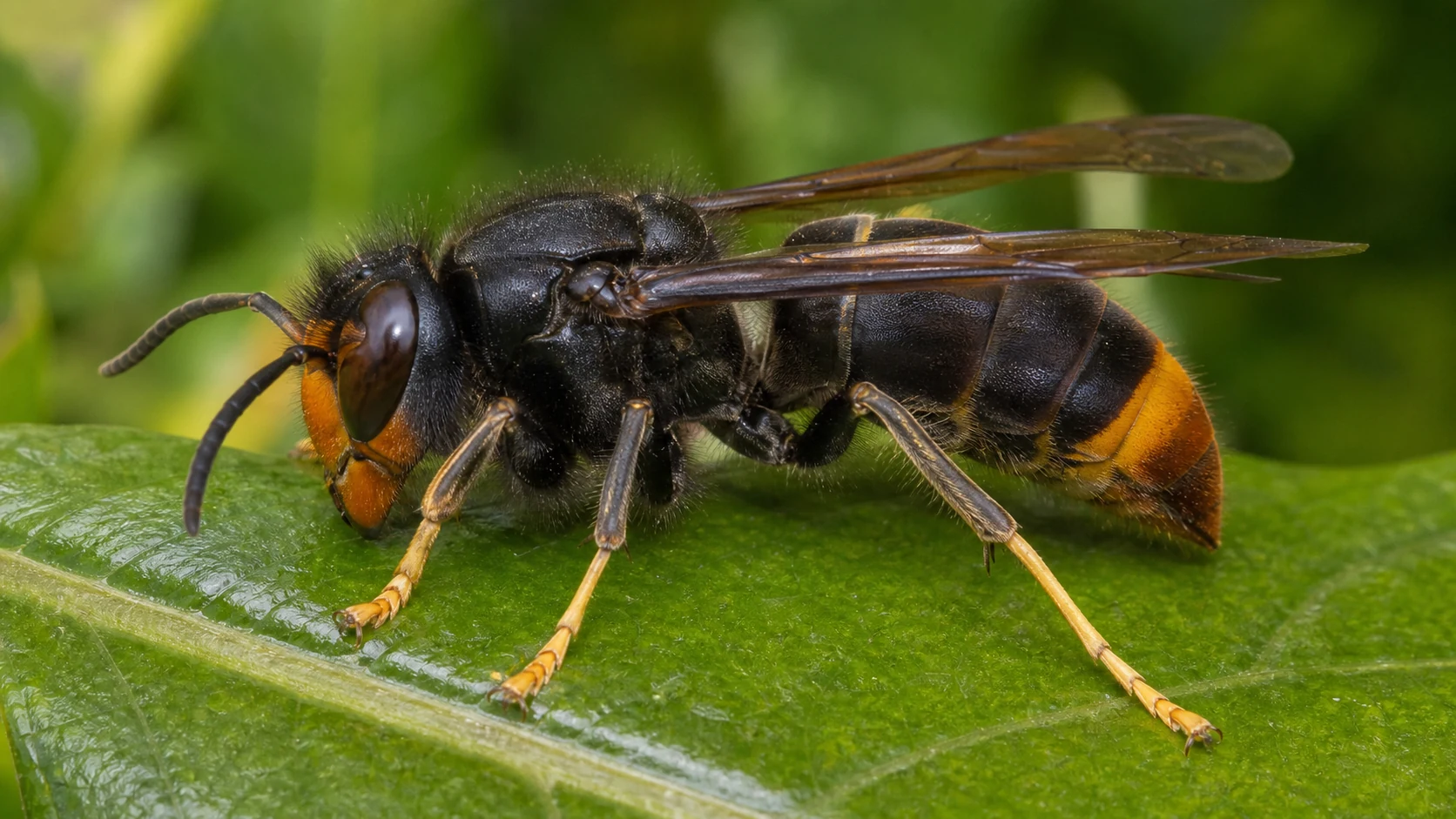
The Asian hornet, also called the yellow-legged hornet, is mostly dark, almost black, with a single orange-yellow band near the tail, an orange face and distinctly yellow leg tips. Our native European hornet is noticeably larger and much more yellow overall, and a common wasp is smaller and boldly striped along the whole abdomen. The yellow leg ends are the detail most people find easiest to hold on to. Our full Asian hornet identification and reporting guide sets the two hornets side by side, and if what you are seeing turns out to be something more ordinary, our pages on wasps and on bees and hornets cover those. Late summer is peak season for stinging insect calls generally, which we cover in our guide to wasp season in the UK.
Misidentification runs both ways, and native hornets get killed on suspicion every season. A native European hornet is a beneficial insect and is not a species anyone should be destroying on a guess. Photograph first, identify second, act third.
What should you do if you think you have seen one?
Report it. Suspected sightings should go through the Asian Hornet Watch app or the official online reporting form, ideally with a photograph. This is the one pest where the correct first call is not to a pest control company at all: confirmed Asian hornet nests are tracked and destroyed by the national authorities, because finding and removing every nest is what stops the species establishing.
What we can do is help you work out what you are dealing with. Our technicians handle stinging insects every day of the season, and we are happy to look at a photograph and a description. If it is a wasp nest or a native hornet nest, we can usually treat it the same day across our areas, and every visit is carried out by an RSPH (BPCA) Level 2 certified and trained technician. If we think it is a genuine Asian hornet, we will tell you and make sure it goes through the official route rather than being dealt with privately. We are open every day except Christmas Day, early until late. Send us a photo through the contact form or call the number at the top of the page.
One thing to avoid entirely: do not spray, knock down or block up a suspected nest. Beyond the risk to you, a disturbed or partially treated nest can scatter the colony and makes the official response harder.
Frequently asked questions
The National Bee Unit records 167 credible yellow-legged hornet sightings in the UK in 2026 and 53 nests found, as at 3 September 2026. The nest list is published in full with locations and dates, and is updated through the season.
The most northerly nest recorded in 2026 is a secondary nest at Chadderton in Greater Manchester, logged on 19 August 2026. The first nest of the year was an embryo nest at Chesterfield in Derbyshire on 26 April 2026.
Away from the nest they are not aggressive towards people, and a sting is painful but generally comparable to a wasp sting. The real risk is disturbing a nest, because they defend it in numbers. Anyone who knows they react badly to stings should treat them with the same caution as wasps.
No, and no private company should. Suspected Asian hornet nests in the UK are handled by the national authorities as part of the eradication programme. We will help you identify what you have found and make sure it is reported correctly, and we can treat wasp and native hornet nests in the normal way.