Bees and hornets are very different from wasps and they need very different handling. JG Pest Control will refer almost every honeybee swarm to a local beekeeping association free of charge, will deal with bumblebee nests only in very specific welfare circumstances, and will respond to hornet nests (European and the newly arrived Asian hornet) with the same urgency as a wasp nest. Every job is carried out by a BPCA Level 2 Certified Technician.
This is the JG hub for bee and hornet problems in the UK. It covers species identification (the bit that matters most), what we do and what we don’t do, why honeybees are protected and why Asian hornets should be reported to national authorities, and what to expect if you call. For a free phone diagnosis, call 0330 053 9002 .

HONEYBEES SAVED, HORNETS HANDLED SAFELY.
About Bees and Hornets in the UK
The UK has one honeybee species (the European honeybee, Apis mellifera), around 27 bumblebee species, hundreds of solitary bees, and two hornet species (the native European hornet, Vespa crabro, and the newly arrived Asian hornet, Vespa velutina nigrithorax). Telling them apart is the first and most important step on any “bee” call.
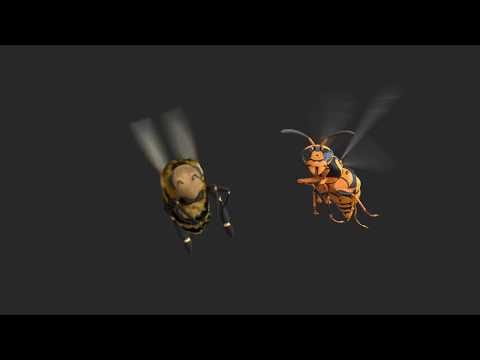
Honeybees (12 to 15 mm, golden-brown, hairy, in a colony of 20,000 to 80,000) form a permanent colony with stored honey and wax comb, and a swarm in May or June is a normal sign of healthy colony division, not a problem to be exterminated. Bumblebees (10 to 25 mm, much hairier, often with bold yellow, white or red bands) form small annual colonies of just 50 to 400, usually in a tussock, under decking or in a disused mouse hole, and die out naturally in autumn. Solitary bees are non-aggressive, single-female nesters in bare soil or walls, of no pest concern. European hornets (18 to 25 mm, brown thorax with yellow abdomen, paler than the chestnut/black Asian hornet) build paper nests of 100 to 700 workers in lofts and hollow trees and are far less aggressive than common wasps. Asian hornets (around 25 mm, very dark thorax, characteristic yellow leg tips) are a recently arrived invasive species, a serious threat to honeybee colonies, and any sighting should be reported to the UK Asian Hornet Watch.
Quick Identification
- Honeybee: 12 mm, golden-brown, hairy, slim
- Bumblebee: 10 to 25 mm, very hairy, bold bands
- Solitary bee: small, often in walls or soil
- European hornet: 18 to 25 mm, brown/yellow
- Asian hornet: 25 mm, very dark, yellow leg tips
- Common wasp: 12 to 17 mm, slim, shiny yellow/black
Not sure what you have? Photograph it and call 0330 053 9002 for a free phone ID.
What JG Will and Will Not Do
Our approach to bees and hornets is led by species and welfare, not by a one-size-fits-all “kill it” response.
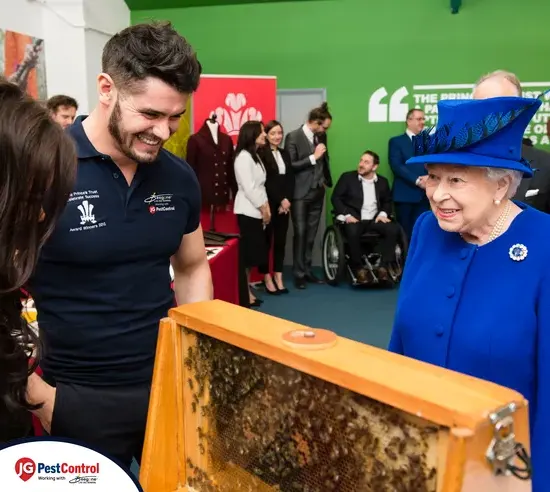
Honeybee swarms: we will not treat a honeybee swarm. Swarms are a normal part of colony reproduction and almost always settle for a short time before moving on to a permanent home found by their scouts. Where the swarm has settled on a hedge or fence post and is causing concern, we will put you in touch with your local British Beekeepers Association (BBKA) swarm collector free of charge. Most areas have a coordinator and a same-day collection is normal. Honeybees are not strictly legally protected as a species (unlike, say, all British wild birds) but they are a critical pollinator and JG will not destroy a viable colony when a beekeeper can take it.
Honeybee colonies in a building cavity: these are harder. A colony established in a chimney, soffit box or cavity wall is essentially impossible to remove cleanly without significant building work, and many beekeepers will decline a cut-out for that reason. Where a colony genuinely cannot be relocated and is creating a significant safety, public health or structural issue (allergic occupant, ongoing repeated stinging, comb collapsing into a heated cavity), JG will discuss the options in detail. Destruction is always the last resort and we will document the decision in writing.
Bumblebees: bumblebee colonies are short-lived (May to September), small and non-aggressive. We will almost always recommend leaving them alone, with the colony dying naturally in autumn and the location simply needing to be sealed once empty to prevent re-use. Where the nest is in an unworkable location (above a doorway used by a known anaphylactic occupant, for example) we will provide a treatment quote.
Solitary bees: never treated. These bees are not colonial, do not defend a nest aggressively and pose no realistic stinging risk. If they are coming through old mortar in a wall, we will recommend repointing in the autumn after the breeding season.
European hornets: treated on the same basis as wasps. The nest is destroyed with a long-reach professional insecticide dust application, usually within 15 to 30 minutes on site. European hornets are far less aggressive than common wasps and most nests are tolerable if they are well away from occupied areas, but we will treat where the nest is near a doorway or in a loft.
Asian hornets: any suspected Asian hornet should be photographed and reported to the UK Asian Hornet Watch (national authorities run an official tracking and response programme). JG will treat nests under coordination with the relevant authorities and following the established Defra/NBU protocol.
What to Do First
- Photograph the insect (clear, close)
- Photograph the nest entry, if visible
- Note location: tree, soffit, loft, ground
- Do not spray with anything
- Keep children and pets indoors
- Call 0330 053 9002 for free ID
Our Bee and Hornet Process
The first step on any “bee” call is identification. The right answer for the call depends on what species the call really involves.
For honeybee swarms, we will take a photograph (or ask you to send one), confirm honeybee identity, and put you in touch with your local BBKA swarm collector free of charge. We do not charge for this referral.
For bumblebee nests, we will confirm species, advise on whether the nest can sensibly be left to die out naturally (almost always yes), and quote treatment only where there is a clear welfare or safety reason to treat.
For solitary bees in walls, we will recommend leaving and repointing in the autumn.
For European hornet nests, we will quote a fixed-price treatment, attend same-day where possible, and apply professional insecticide dust to the nest entry. Most jobs take 15 to 30 minutes on site.
For suspected Asian hornets, we will ask you to report the sighting to the UK Asian Hornet Watch and coordinate any treatment under Defra/NBU protocol.
For wasp nests (which are by far the most common “I think there’s a bee nest” call), we treat under our standard wasp nest removal service.
Every job carries a written guarantee and is carried out by a BPCA Level 2 Certified Technician.
Decision Path
- Honeybee swarm = beekeeper referral (free)
- Honeybee in cavity = case-by-case
- Bumblebee = leave alone where possible
- Solitary bee = leave, repoint later
- European hornet = treat as wasp
- Asian hornet = report + coordinated treatment
- Common wasp = standard wasp removal
For BPCA Level 2 Certified bee, hornet and wasp identification, call 0330 053 9002
Related Services and Local Coverage
JG run bee identification, beekeeper referral, bumblebee advice, hornet treatment and wasp nest removal across the entire UK, with same-day cover for wasp and hornet jobs in major cities.
Related services:
City coverage examples:
- Pest control in London
- Pest control in Essex
- Pest control in Manchester
- Pest control in Sheffield
- Pest control in Newcastle
- Pest control in Bristol
Not listed? Call 0330 053 9002 . We cover mainland UK and can usually be on site same day for wasp and hornet jobs during the season.

Trusted by 23,000+ Trustpilot reviewers, rated 4.8 out of 5. BPCA Level 2 Certified Technicians on every job. Honeybees referred to local BBKA collectors free of charge.
Why Choose JG Pest Control
- BPCA Level 2 Certified Technicians on every job
- Open every weekend and every bank holiday except Christmas Day
- Honeybee swarms referred to local beekeepers free of charge
- Bumblebees and solitary bees almost never treated
- European hornet nests treated same-day where possible
- Asian hornet treatment under Defra/NBU coordination
- Trusted by 23,000+ Trustpilot reviewers, rated 4.8 out of 5
- Founded in 2010, 15+ years of UK stinging insect work
Open early, late, every weekend, every bank holiday (except Christmas Day). Call 0330 053 9002
Frequently Asked Questions: Bees and Hornets
How quickly can you get to me?
For European hornet and confirmed wasp jobs, same-day cover is standard during the season across London, Manchester, Sheffield, Bristol, Newcastle and Essex. Anywhere else in mainland UK we aim to be on site within 24 hours. For honeybee swarm referrals, the local BBKA collector usually attends within hours. Out of hours our national line on 0330 053 9002 rolls 24/7.
Are you available weekends and bank holidays?
Yes. JG Pest Control is open every weekend, every bank holiday except Christmas Day, with the phone line staffed early in the morning through to late in the evening. Honeybee swarms are particularly common on bank holidays and we handle the beekeeper referral on the same call.
I have a swarm in my garden. Will you destroy it?
If it is a honeybee swarm, no, almost certainly not. We will identify the species (photograph if possible), confirm honeybee, and put you in touch with your local BBKA swarm collector free of charge. Most settled swarms move on naturally within 24 to 72 hours anyway.
I have something that looks like a wasp nest in the eaves. Could it be hornets?
Possibly. European hornets do nest in loft and soffit boxes. A clear photo of one of the insects (and the nest entry) will usually confirm species. European hornets are larger than wasps (18 to 25 mm), with a more brown-toned thorax. We treat European hornet nests on the same basis as wasps.
What do I do if I think I have seen an Asian hornet?
Photograph it and report the sighting to the UK Asian Hornet Watch through their official channels. Do not attempt to treat the nest yourself. Asian hornets are a serious threat to honeybee colonies and are being actively tracked by Defra and the National Bee Unit. JG will coordinate any treatment under the official protocol.
Will the treatment harm pets or children?
For hornet and wasp nests, treatment is targeted at the nest entry using professional insecticide dust applied with a long-reach lance. There is no broadcast spraying. Pets and children stay indoors during treatment and for around 2 hours afterwards.
Do I need to leave the property?
No. Hornet and wasp nest treatment is done from outside (or from the loft hatch) in 15 to 30 minutes with you staying inside.
How much does treatment cost?
A typical European hornet or wasp nest is a fixed-price call-out, quoted on the phone. Asian hornet work is coordinated with the National Bee Unit and is usually delivered without charge to the homeowner. Honeybee referrals to BBKA collectors are free. Call 0330 053 9002 .
Are your technicians qualified?
Every job is carried out by a BPCA Level 2 Certified Technician, the recognised UK industry qualification for pest management. JG Pest Control was founded in 2010 and has been delivering stinging insect identification, beekeeper referral and hornet/wasp treatment across the UK for more than 15 years.
For free bee identification, beekeeper referral or hornet nest removal, call JG Pest Control on 0330 053 9002