
BirdAlert listens before it acts. Conventional scarers play noise on a timer, and birds work them out within weeks. BirdAlert waits until it hears the species actually causing trouble, then answers with that species’ own distress call.
JG surveys the site, installs and commissions the system, and monitors it afterwards.
How it works
The unit listens through a microphone with a detection range of up to 250 metres. When it recognises a species you have told it to act on, it plays that species’ distress call through weatherproof speakers, and only then.
That order of events is the whole point. Birds hear an alarm triggered by their own arrival, not a recording that plays every twenty minutes regardless. That is far harder to habituate to, which is why a timer-based scarer stops working in a few weeks and this does not.
Species it knows
Built for gulls, rooks, geese and starlings. In practice it also identifies crows and jackdaws.
250 metre range
Detection radius from a single unit, which is what makes it viable across open ground.
Five outputs
Drives speakers, a gas cannon, a kite controller, a reflector or an inflatable, as the site needs.
Changed remotely
Species, volumes and active hours are set through an online portal, without a site visit.
The activation log
Every response is logged by species. That turns a deterrent into a record of your own bird pressure, which is what tells you whether the problem is gulls at dawn or rooks all afternoon, and whether it is improving.
Power and mounting
Sites that need dispersal rarely have a convenient socket, so the unit is built to run without one.
Runs on battery between services
A 33Ah battery runs the unit on its own. Around a week is typical, but run time depends on how often the system activates: a site with heavy bird pressure triggers more often and drains the battery faster. We size the battery and set the service interval to the site.
Solar and tripod
Optional, and what makes it genuinely standalone on landfill cells and ground that changes shape.
Mains where available
A 230V charger, for sites where mains power is available.
Moves with the problem
15 kg and roughly shoebox sized before the microphone, so it can be resited.
Where BirdAlert earns its place
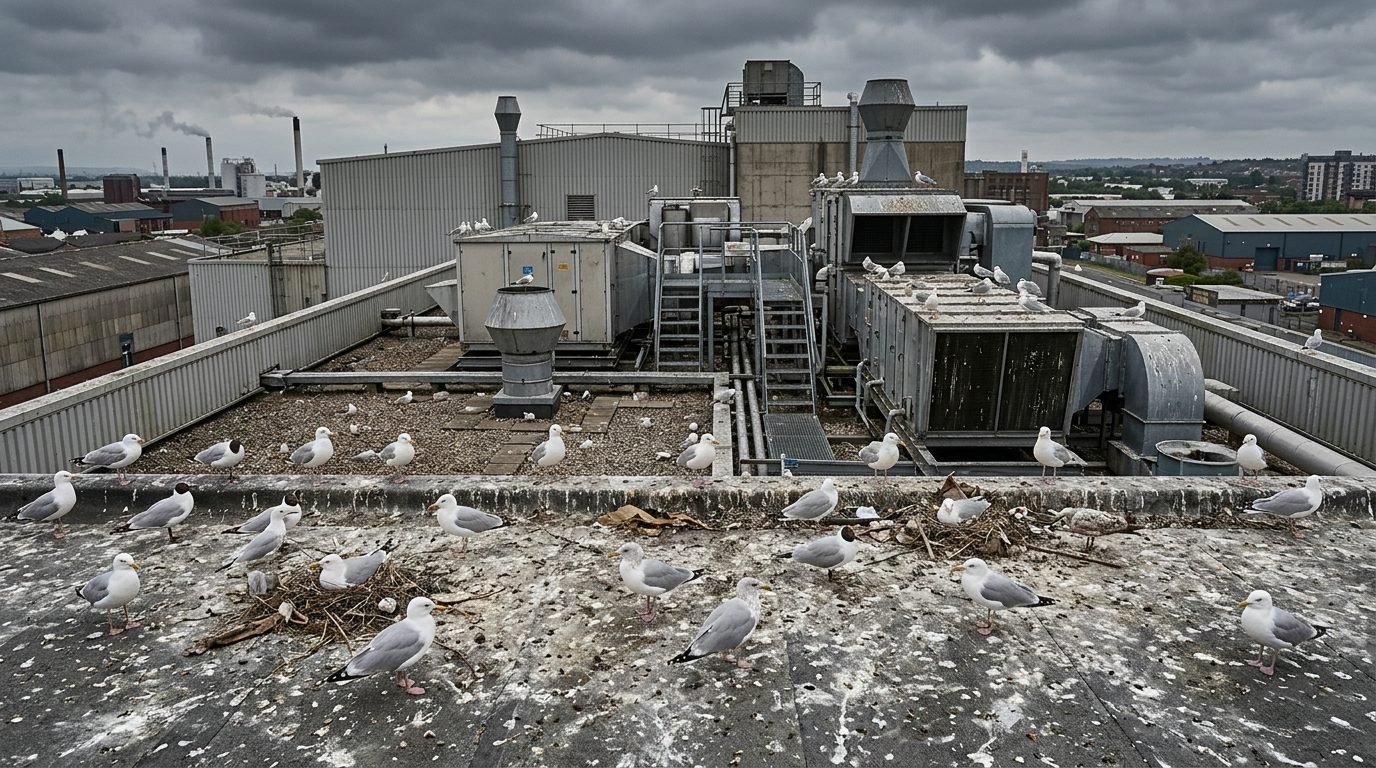
The maker developed it for dealerships, corporate buildings, hotels, hospitals, airports, recycling plants, refuse tips and farms. It works hardest where the area is too large to proof and the birds carry a real cost.
Waste and landfill
Gulls and corvids in numbers, over ground that changes weekly.
Food production
Where a bird inside the building is an audit failure, not a nuisance.
Agriculture and grain
Crop and stock losses, and contamination of stored feed.
Marinas and quaysides
Persistent gull pressure over open water and hardstanding.
The honest limitation: noise
An acoustic system produces distress calls at volume. On a site with housing over the boundary that is a neighbour and planning question before it is a technical one, and it is better raised at survey than after the first complaint.
Where noise rules it out, laser dispersal is silent and is usually the right alternative. We would rather say that at the survey than install something that has to come out again.
What JG does
Survey
What species, in what numbers, arriving when and from where. A system set for the wrong species is an expensive ornament.
Install and commission
Mounting, power, speaker placement and configuration against what the survey found.
Monitor
We review the log and adjust as pressure changes through the year.
Service
A unit set for gulls in March may be aimed at the wrong problem by September.
The law, briefly
All wild birds are protected under the Wildlife and Countryside Act 1981, and a nest is protected while it is being built or in use. Dispersal moves birds on without harming them, and must not injure or trap a bird or stop one reaching an active nest.
Some species and actions are permitted only under licence, and those licences differ across England, Scotland, Wales and Northern Ireland. Gulls are more tightly licensed than feral pigeons. We check what applies before anything is installed.
Noise a problem on your site?
Where an acoustic system would draw complaints, a laser is silent. Same survey, different tool.

Getting a survey
BirdAlert is quoted from a survey, never from a phone call, because the species, the numbers, the arrival pattern and the neighbours all change what can be installed.
Get in touch or send us the site details and the team will come back to you.