
Bird droppings are a biohazard, not a cleaning job. Built-up guano carries organisms that become airborne the moment it is disturbed, which is exactly what a pressure washer does. JG surveys the site, clears and disinfects it under controlled conditions, disposes of the waste properly, and then proofs the area so it does not come back.

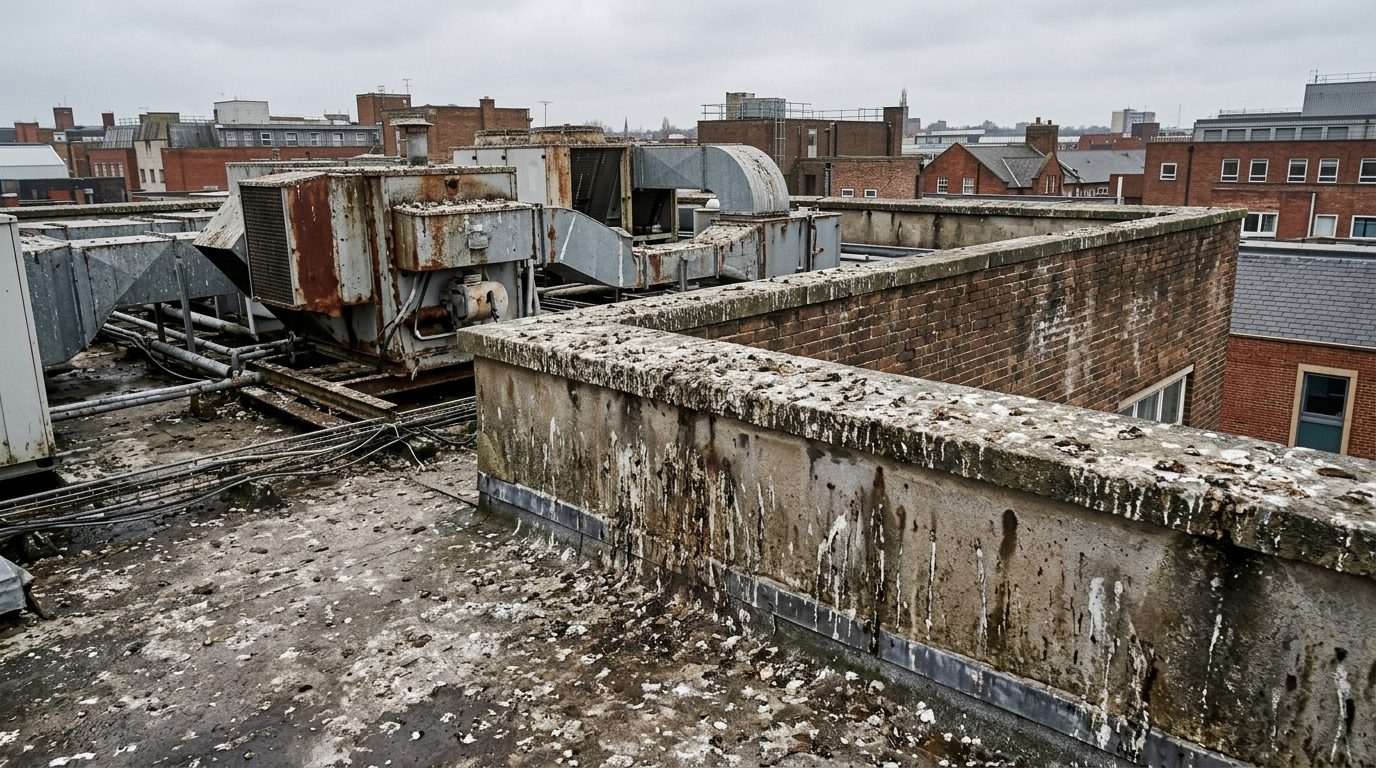
Why it matters beyond the mess
Health risk
Accumulated droppings are associated with organisms including salmonella, E. coli, psittacosis and, in dry dusty deposits, histoplasmosis. The risk comes from inhaling disturbed material.
Structural damage
Guano is acidic. Left on roofing, render, stonework and metal it degrades the surface, and on a listed or rendered building that becomes expensive.
Blocked drainage
Fouling washes into gutters, hoppers and outlets. Water then backs up, and the first anyone knows is a leak.
Slip hazard
Wet droppings on a walkway, fire escape or loading area are a genuine safety issue and an obvious one at an inspection.
Audit failure
In food production, healthcare or hospitality, visible fouling near an intake or opening is a finding before anyone tests anything.
Insect follow-on
Nests and droppings support bird mites and beetles, which move indoors once the birds leave. See bird mites.
Why a pressure washer is the wrong tool
The instinct is to blast it off. That is the one approach guaranteed to make it worse, because it turns dried droppings into an aerosol that travels, settles elsewhere and gets drawn into air intakes and open windows.
Controlled clearance works the other way round: the material is treated and kept damp so it cannot become airborne, removed rather than dispersed, and the surface disinfected afterwards.
How we do it
Survey and risk assessment
What is there, how deep, how dry, what is directly below and beside it, and what access the work needs.
Containment
Sheeting and screening where required, and air intakes and openings protected before anything is touched.
Biocide and damping
Treated and kept damp so material is lifted rather than aerosolised. Technicians work in appropriate protective and respiratory equipment.
Removal and disposal
Bagged and removed as controlled waste under our duty of care, not swept into a skip.
Disinfection
Surfaces disinfected after clearance, not just cleared, and left in a state you could reasonably inspect.
Clearance and proofing belong in the same visit
This is the single most common false economy we see. A site pays to have years of fouling cleared, does not proof the ledge or the void, and the birds are back on it within weeks because nothing about the building changed.
Where the budget only stretches to one, proofing first is usually the better buy: it stops the accumulation getting worse while you plan the clearance. We will tell you which way round makes sense on your building rather than quoting both by reflex.
The law, briefly
All wild birds are protected under the Wildlife and Countryside Act 1981, and a nest is protected while it is being built or in use. That directly affects timing: an area with active nests cannot simply be cleared, and the work has to be planned around it.
Waste from clearance carries a duty of care on disposal, and the work itself falls under COSHH. We handle both as part of the job rather than leaving you holding them.
Where we do this
Commercial roofs and plant areas
The most common by a distance, and usually the worst because nobody goes up there.
Food production and warehousing
Where fouling near an intake or opening is an audit finding.
Retail and shopping centres
Canopies, service yards, signage and anywhere the public can see it.
Car parks and transport
Decks, undercrofts and station canopies, where the slip risk is the driver.
Residential blocks
Balconies, light wells and communal roof spaces.
Listed and rendered buildings
Where the acid damage is the real cost and the method has to suit the fabric.
Too big to net? Disperse instead
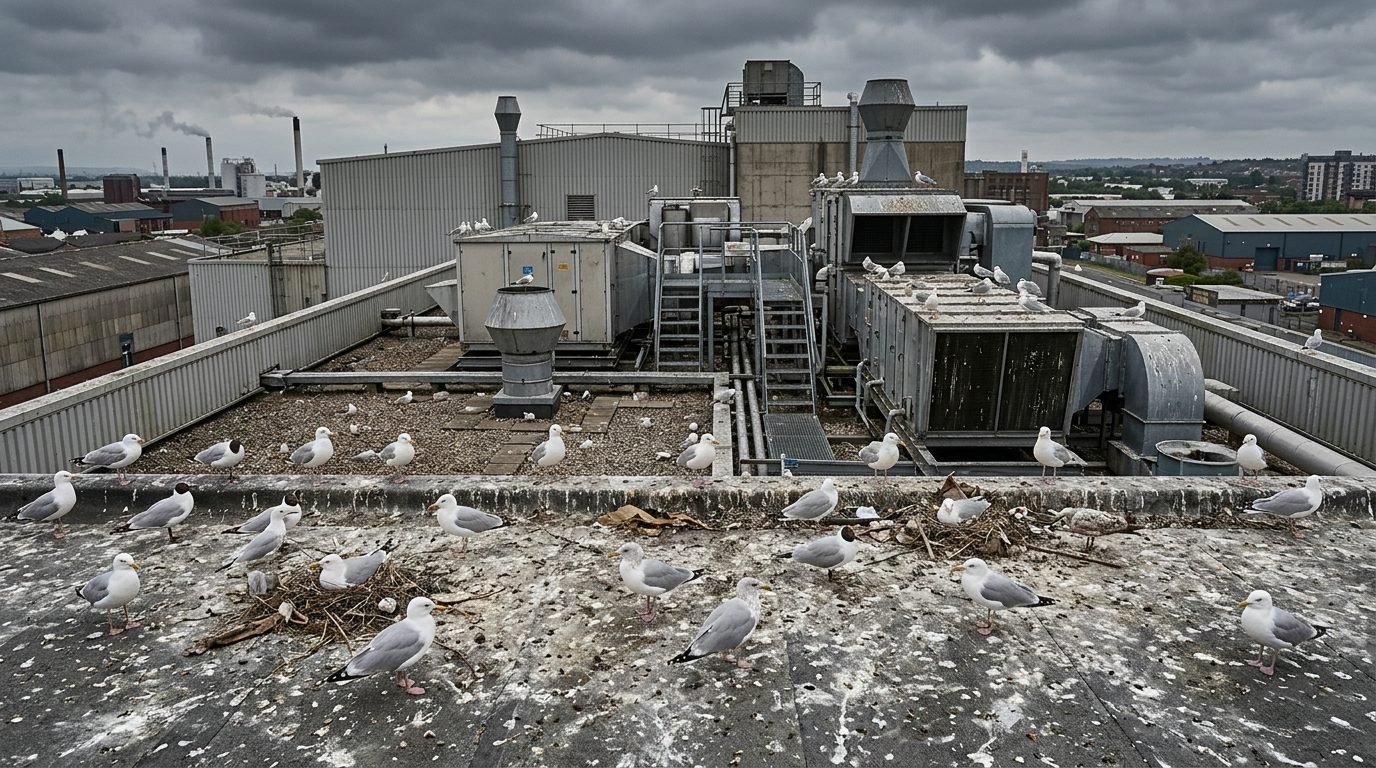
Two systems that clear birds off ground far too large to proof. We survey, install, commission and service both.

Arranging a survey
Clearance is always quoted from a survey. Depth, area, how dry the material is, what sits below it and how we reach it all change the method and the cost, and none of that can be judged from a photograph.
Get in touch or send us the site details and a member of the team will come back to you. Our wider work is on the bird control and decontamination pages.