
Bird netting is the most complete way to keep birds out of a space. Where spikes stop birds landing on a ledge, netting closes the whole opening, so a roof void, a canopy, a light well or a loading bay simply stops being available. Done properly it is a permanent answer rather than a seasonal one.

JG surveys the building, specifies the right mesh and fixings, clears what the birds have already left behind, and installs the system.
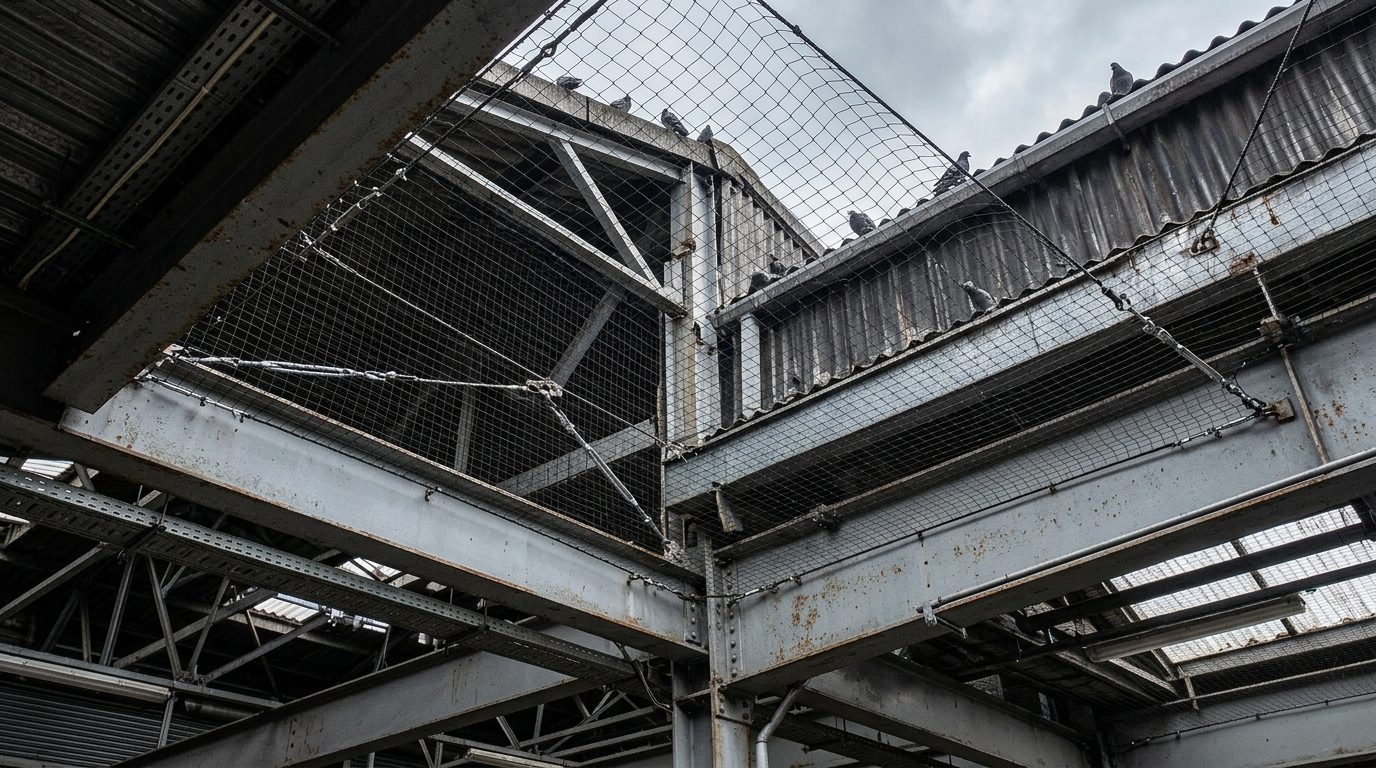
When netting is the right answer
Openings, not ledges
Netting closes a void, canopy, light well or plant area. For a narrow ledge where birds only perch, spikes are usually cheaper and less intrusive.
Heavy, established pressure
Where birds are nesting rather than passing through, exclusion works where deterrence does not.
Where fouling is the cost
Guano on stock, walkways, signage or plant, and the cleaning bill that comes with it.
Where you need it to last
A correctly tensioned system is a long-term structural fix, not something reapplied each spring.
Mesh size is chosen by species
This is the detail that decides whether a system works. Netting sized for pigeons will not keep sparrows out, and a bird small enough to get through is a bird that will nest inside a space you have just made harder to reach.
19mm - sparrows
The smallest common specification, used where house sparrows are the problem.
28mm - starlings
Excludes starlings and anything larger.
50mm - pigeons
The most common commercial specification, and the usual answer to feral pigeons.
75mm - gulls
Used where gulls are the target species and smaller birds are not an issue.
If more than one species is using the building, the netting is specified for the smallest of them. We work that out at survey rather than assuming.
Why installation quality is the whole job
Bird netting is sold as a product and delivered as a system, and the difference between the two is where most failures come from.
Tension
A slack net sags, pools water and eventually tears. Correct tension on wire rope is what gives a system its working life.
Perimeter fixings
Every edge has to be closed to the structure. Birds find the one corner that was not, and they find it quickly.
No entrapment
A net has to exclude birds without trapping any inside. That means checking the space is clear before it is closed.
Access afterwards
Plant, gutters and roof lights still need reaching. Zips and access panels are designed in, not cut in later.
Guano clearance comes first
Netting a space that is already fouled seals the problem in. Bird droppings carry a genuine health risk and the residue keeps attracting birds to the outside of the net, so clearance and disinfection come before installation, not after. Our decontamination work covers that side.
Where we install it
Food production and warehousing
Roof voids and loading bays, where a bird inside the building is an audit failure.
Retail and shopping centres
Canopies, service yards and signage, where fouling is in front of customers.
Car parks and transport
Multi-storey decks, station canopies and undercrofts.
Industrial and manufacturing
Steel-framed roof voids and external plant areas.
Residential blocks
Balconies, light wells and communal roof spaces.
Listed and sensitive buildings
Where fixings and appearance need care, and a reversible system matters.
The law, briefly
All wild birds are protected under the Wildlife and Countryside Act 1981, and a nest is protected while it is being built or in use. That has a direct practical consequence for netting: a space cannot be closed while there is an active nest inside it, and the work has to be timed around that.
Netting must also be installed so that no bird can become trapped behind it. That is both a legal and a welfare matter, and it is the single most common thing done badly by installers working to a price.
What JG does
Survey
Which species, where they are getting in, what the structure allows, and what access the work needs.
Clear and disinfect
Guano removal and disinfection before anything is closed in.
Install
Mesh specified to the species, tensioned on wire rope, perimeter fully closed, access designed in.
Maintain
Buildings move and fixings weather. Periodic checks are what keep a system working for years.
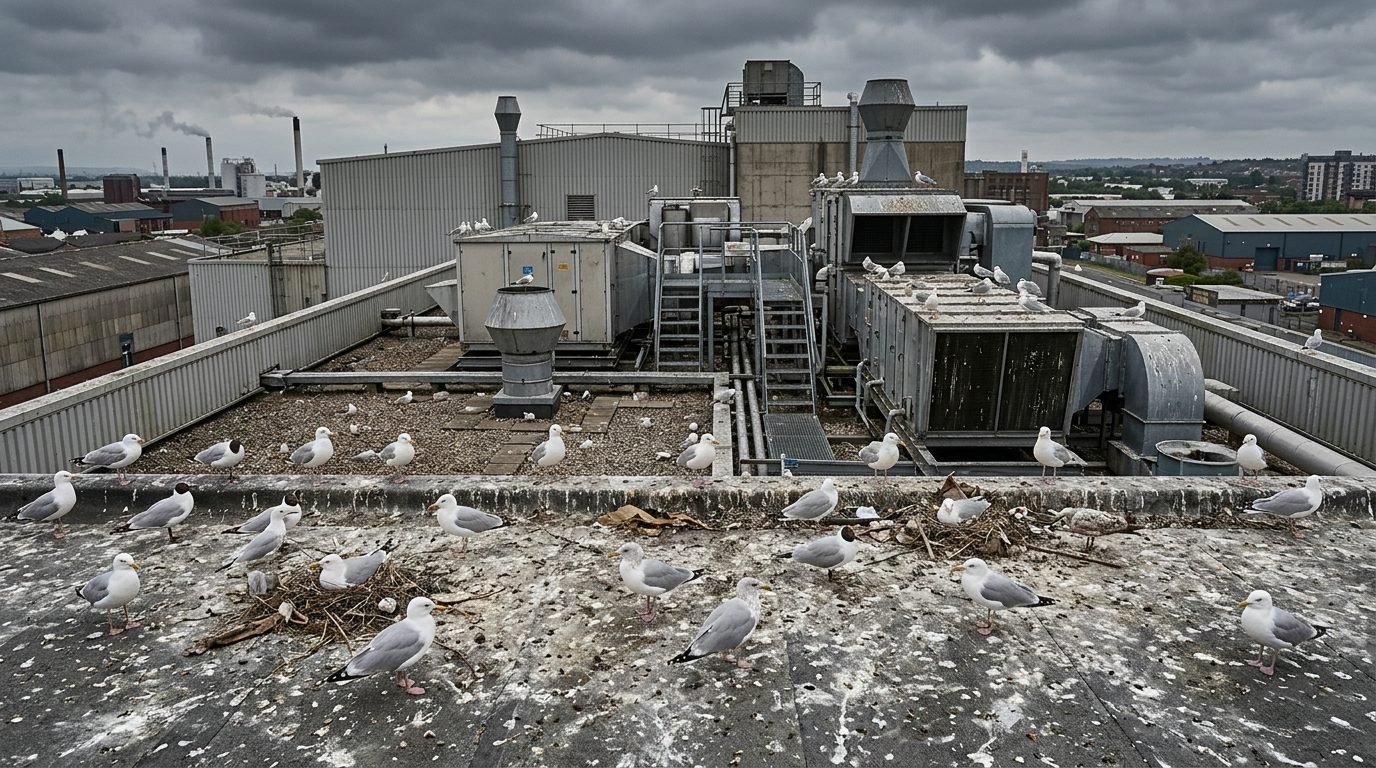
Too big to net? Disperse instead
Two systems that clear birds off ground far too large to proof. We survey, install, commission and service both.

Arranging a survey
Netting is always quoted from a survey. The species, the size of the opening, the structure available to fix to and the access required all change the specification and the cost of the work, and none of them can be judged over the phone.
Get in touch or send us the building details and a member of the team will come back to you. The other options are on our bird control page.
Trade and materials supply across the group is handled by our bird specialists at birdcontrol.uk.com. Installation, survey and maintenance stay with us.