
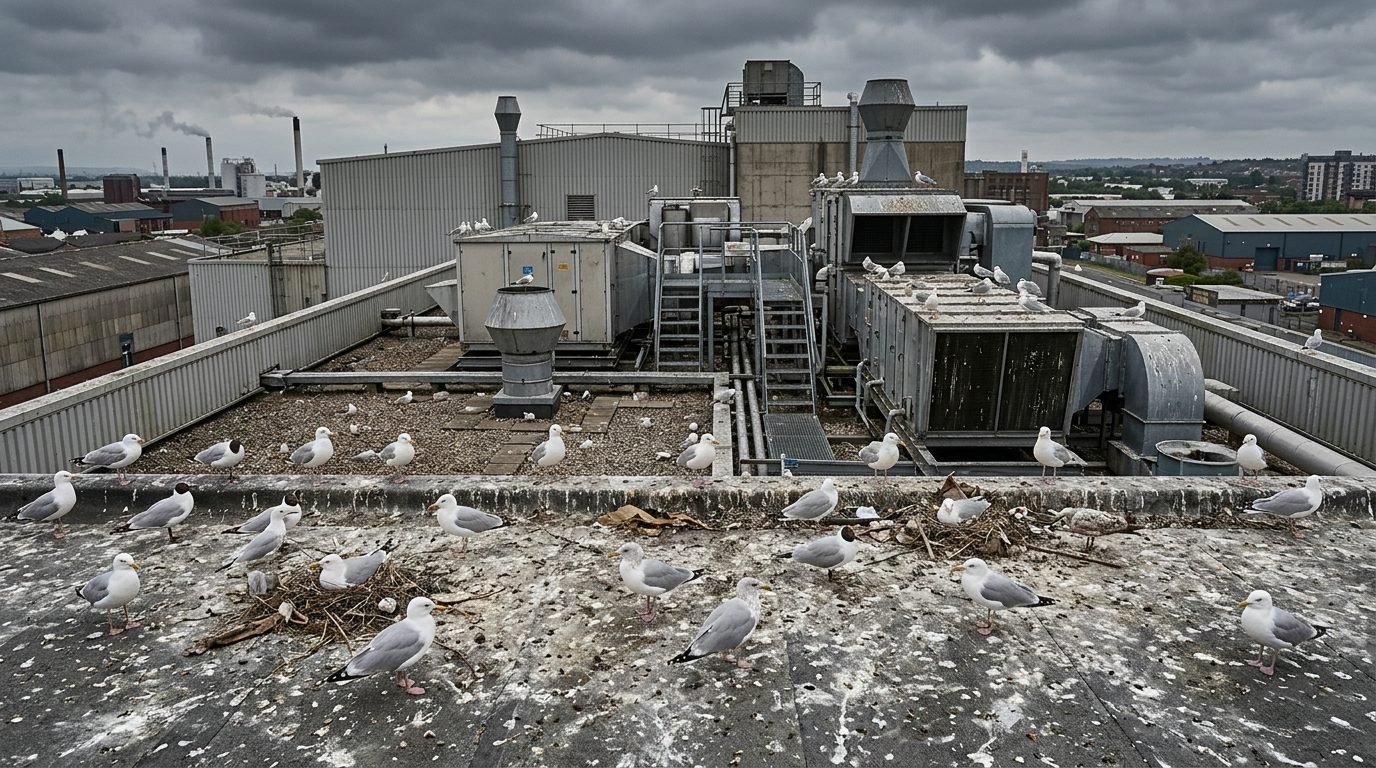
Some bird problems cannot be netted or spiked. Open yards, working roofs, landfill cells, quaysides and grain stores are too large, too busy or too changeable to proof, and the birds are not perching - they are arriving. That is what dispersal is for.

JG surveys the site, specifies the right system, supplies it, installs and commissions it, and services it afterwards.

Dispersal or proofing?
They solve different problems, and most sites we survey need both.
Proofing is physical
Netting, mesh, wire and spikes change the building so birds cannot land or nest. Permanent, right for ledges and voids, and useless against birds on open ground.
Dispersal is behavioural
It makes an area unattractive enough that birds move on, across spaces far too big to net. It needs power and maintenance, and works on the birds rather than the structure.
If someone proposes one without looking at the other, they are selling you a product rather than solving your problem.
The sites these suit
Dispersal earns its place where the area is too large or too operational to proof, and where birds carry a real cost.
Food production and distribution
Where a bird inside the building is an audit failure, not just a nuisance.
Waste transfer and landfill
Gulls and corvids in numbers, over ground that changes shape weekly.
Agriculture and grain storage
Crop and stock losses, and contamination of stored feed.
Marinas and quaysides
Persistent gull pressure over open water and hardstanding.
Large roofs and solar arrays
Fouling, blocked drainage and access problems across areas too big to net.
Industrial estates
Open service yards and plant areas where birds arrive rather than roost.
Where pressure is heavy and constant, dispersal is often paired with bird of prey deterrence. A trained hawk works on the same instinct as a laser, and on some sites the two together move birds off faster than either alone.
Why a dispersal laser is installed, not delivered
Dispersal lasers are powerful enough that direct exposure to the beam is hazardous to eyes, and we confirm the safety classification of the specific unit at survey. That drives everything about how one is sited.
Beam paths are planned
They must not reach people, windows, roads, footpaths or reflective surfaces, and the unit has to be mounted so it stays that way.
Aviation matters
Directing a laser towards an aircraft is a criminal offence in the UK, so anything near an airfield, helipad or approach path needs real care at survey.
You get the documentation
We hand over a system with its beam paths recorded, not a box with a manual in it.
Trained operators only
It is surveyed, installed and commissioned by people who do it for a living. That is the reason it works and stays safe.
What we actually do
Supply, installation and servicing are three separate jobs, and most suppliers only do the first.
Survey
What species, in what numbers, arriving when and from where, and what the site does. A system aimed at the wrong species or the wrong hours is an expensive ornament.
Specify and supply
Laser systems come through our group supplier EnviroGuard, and acoustic systems through PestFix. Both are part of the same Tyro UK Group as JG.
Install and commission
Mounting, power, beam paths or speaker placement, and configuration against what the survey actually found.
Service
Systems drift. Birds adapt and sites change shape. Servicing is what keeps one working in year three rather than year one.
The law, briefly
All wild birds are protected under the Wildlife and Countryside Act 1981, and a nest is protected while it is being built or in use. Dispersal moves birds on without harming them, and it must not injure or trap a bird or stop one reaching an active nest.
Some species and actions are permitted only under licence, and those licences differ across England, Scotland, Wales and Northern Ireland. Gulls in particular are more tightly licensed than feral pigeons. We check what applies to your site and species before anything is installed.
Too big to net? Disperse instead
Two systems that clear birds off ground far too large to proof. We survey, install, commission and service both.
Getting a site survey
Dispersal is quoted from a survey, never from a phone call, because the species, the numbers, the arrival pattern, the neighbours and the beam or sound paths all change what can be installed.
Get in touch or send us the site details and a member of the team will come back to you. The full range is on our bird control page.