
Bird spikes stop birds landing on a ledge. Fitted properly they do not harm birds, and they last years. JG Pest Control surveys the building, specifies and supplies the right system, fits it, and clears what the birds left behind first.

When spikes are the right answer, and when they are not
Spikes work where birds perch. They are the correct choice for ledges, parapets, signage, chimney stacks, gutter runs, security lights and the tops of walls. They stop pigeons and gulls settling on a narrow surface.
Spikes are the wrong choice where birds nest or shelter. An open loft, a roof void, the space under solar panels or a large recessed area needs netting, mesh or panel proofing instead - a spike across the entrance does nothing about the birds already inside. We survey first for this reason. If spikes are not the answer for your building we will tell you, and we would rather do that than fit something that fails in a season.
Spikes also do nothing about birds that are already circling a site in numbers. Where pressure is that heavy, bird of prey deterrence moves them off before proofing is worth fitting. The full range of options is on our bird control page.
What our technicians actually fit
The spike matters less than the fixing. When a system fails early, the fixing is usually why: bonded to a surface that could not hold it, or a base chosen for the wrong ledge width.
- Stainless steel pins on a polycarbonate base for most masonry, stone and rendered ledges. It is the standard for a reason: it will not rust-stain a building the way a galvanised or mild steel system can.
- Narrow-base spikes for signage, pipework and window sills where a standard base overhangs.
- Wide or multi-row systems for deep parapets and flat commercial ledges, where a single row leaves a landing strip behind it.
- Gull spikes where the bird is a herring gull rather than a feral pigeon. They are taller and more widely spaced, and a pigeon spike is not specified for gulls - fitting one where gulls are the problem is a common reason a system underperforms.
Fixing is by adhesive, mechanical fixing or both, decided on site. On a listed building, drilling may need listed building consent, and some rendered surfaces will not take a mechanical fixing at all. Either changes the specification rather than ruling out the job.
Guano clearance comes first
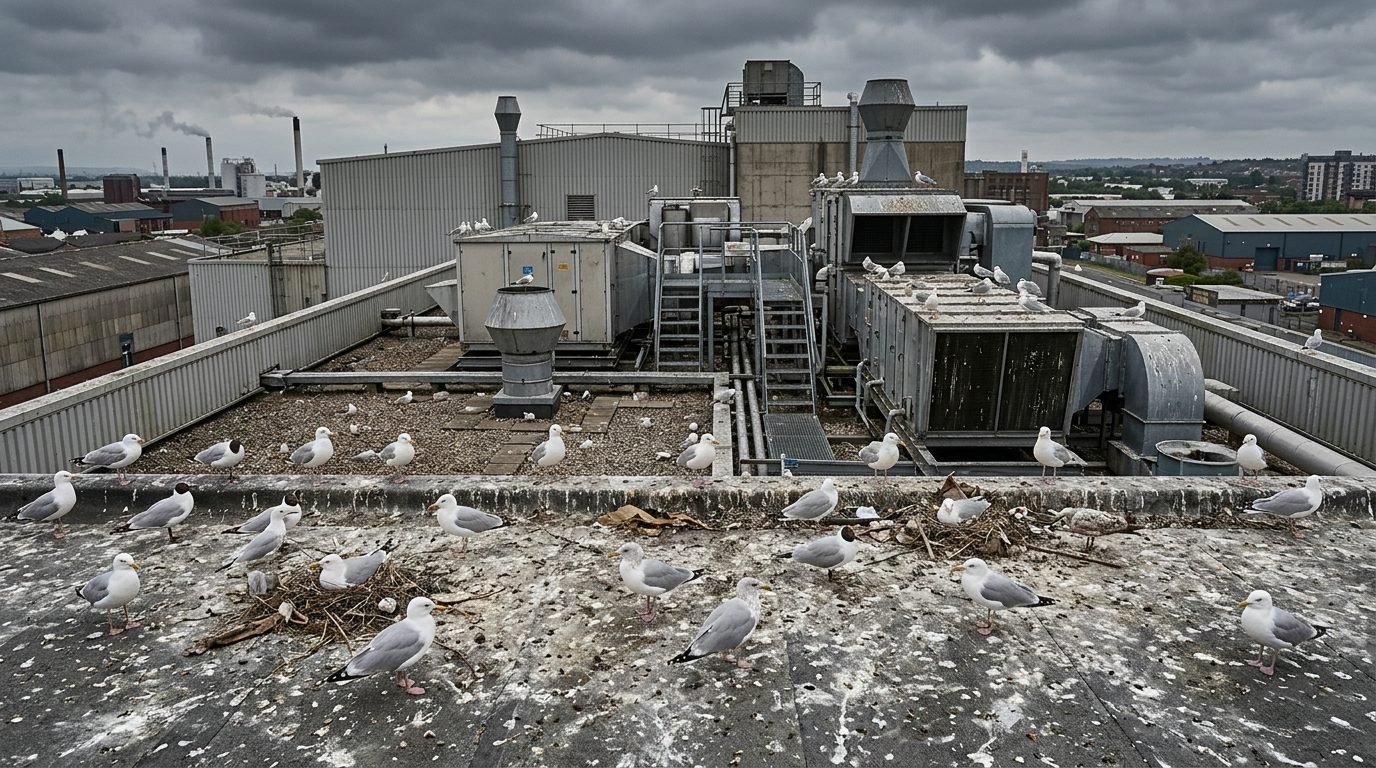
We do not fit spikes on top of droppings. Bird guano is a biohazard, it carries the mites and insects that live in old nests, and adhesive will not bond through it. Clearance, disinfection and, where nests are present and the law allows their removal, that removal is specified and quoted as part of the work rather than discovered afterwards.
The law, briefly
All wild birds are protected under the Wildlife and Countryside Act 1981, and a nest is protected while it is being built or is in use. Proofing that stops birds landing is lawful where it does not trap or injure a bird and does not stop one reaching an active nest.
What changes the position is licensing, not the time of year. Work affecting the nests or eggs of some species is permitted only under licence, and those licences differ by species and by country - feral pigeon and herring gull are not treated the same, and England, Scotland, Wales and Northern Ireland each issue their own. We check what applies to your building and your species before anything is touched. If the answer is that proofing waits until the young have fledged, we will tell you.
How to compare spike systems
Ranges differ on three things, and they are the three worth asking about: the number of pins per metre, the width of the base, and whether that base is polycarbonate or stainless steel. Pin count decides how little of the ledge is left landable, base width has to match the ledge rather than the brand, and base material is what determines whether the system stains the building over time.
For supply, our group company birdcontrol.uk.com stocks bird spike systems, including the BirdOff range. EnviroGuard and PestFix are also part of the Tyro UK Group and supply the trade. Defender and Avipoint are among the other established brands, and all of these ranges span more than one base width, which is why the ledge and not the label should decide the specification.
Supply and installation
Spikes are sold as a product and fitted as a job, and those are not the same decision. At height, on a commercial building, on anything listed, or where guano has built up, this is work for a technician with the access equipment and the biohazard kit to do it safely.
For installation, that is us. JG Pest Control has worked across the UK since 2010 and our technicians are RSPH (BPCA) Level 2 certified. A competent installer specifies the system that suits the building and the species rather than fitting a single default everywhere.
Too big to net? Disperse instead
Two systems that clear birds off ground far too large to proof. We survey, install, commission and service both.

Getting it surveyed
Bird proofing is quoted from a survey, not a phone estimate, because the ledge, the height, the access and the species all change the specification. Tell us the building and what you are seeing and we will arrange one.
Get in touch or send us the details and a member of the team will come back to you.