
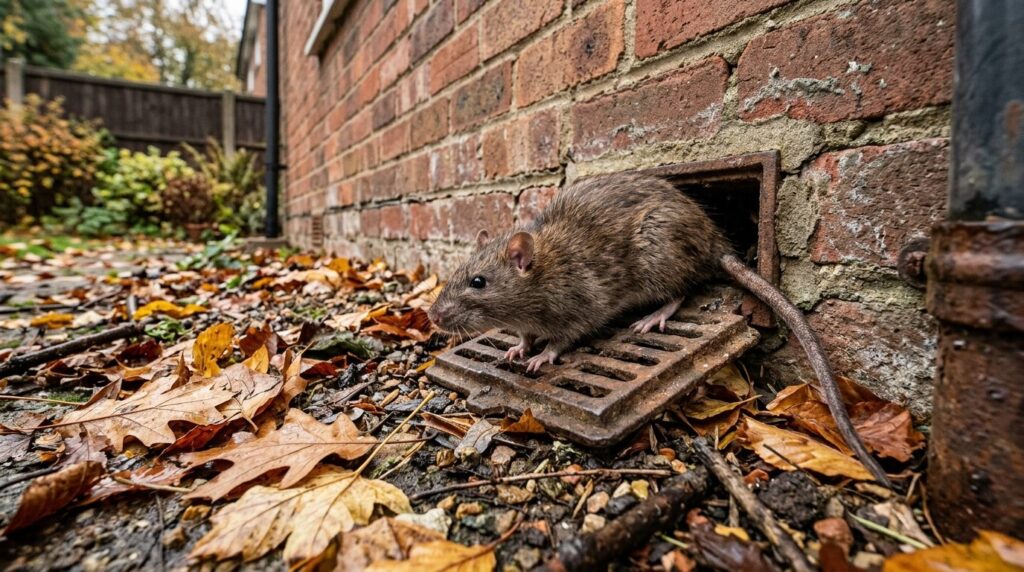
Rats moving about openly in daylight almost always mean a large, well established population rather than a stray animal. Rats prefer to feed at dusk and through the night, so when they are running across open ground in the middle of the day it usually means there are more rats than there is safe night-time foraging to go round. That is the detail worth pulling out of a story reported by Bristol Live on 24 August 2026, in which residents of a tower block in the Lawrence Hill area of Bristol said rats were emerging from bushes and drains around their building during the day, close to a children’s playground.

Key takeaways
- Residents of a Bristol tower block told Bristol Live there “must be at least 100 rats” living in bushes and open drains around the block, and video sent to the paper shows rats out in daylight.
- The local council told Bristol Live its pest control team would visit on Friday 21 August, and that its officers would work with housing officers to investigate the area.
- Regular daytime activity is a severity signal. Rats are built to forage in the dark, so open daylight movement points to a population that has outgrown its cover and food supply.
- Outdoor infestations around buildings are usually held up by two things: dense ground cover for harbourage, and a defective or open drain giving access to the sewer.
- Baiting alone rarely clears an external population. Without a drain survey and cutting back the harbourage, numbers recover.
- Rats can carry leptospirosis, which spreads through rat urine, so contaminated play equipment and ground surfaces are a genuine reason to keep children away until the area has been cleaned.
- Never put down DIY rodenticide in a shared outdoor space. It is unsafe around children, pets and wildlife, and in most tenancies it is not yours to do.
What does it mean when rats are out in the daytime?
It is the question we are asked most often after someone sees one, and the honest answer is that it changes the picture. A single rat crossing a garden at dusk tells you very little. Rats seen repeatedly in full daylight, moving unhurriedly across open ground, tell you a great deal.
Brown rats are neophobic and cautious by nature. They keep to runs along walls and edges, and they do the bulk of their feeding between dusk and dawn because that is when they are least exposed to predators and people. When a population is small, every animal in it can feed comfortably inside that night-time window, in cover, and you may never see one.
Push the numbers up and that stops working. Competition inside a colony is hierarchical, and the animals at the bottom of it get displaced from the best harbourage and the best feeding times. They are forced to forage earlier, later, and further out into the open. So daytime sightings are less a sign that the rats have become bold and more a sign that there are too many of them for the space. The same logic applies when you start seeing them on paths, in car parks and on mown grass rather than tight against cover.
The residents quoted by Bristol Live described exactly that pattern: animals coming out of undergrowth and drains during the day, in numbers, and moving across an open play area. Whether the figure they gave is precise is beside the point. The behaviour itself is the reading.
Why do rats colonise the outside of a building rather than the inside?
People expect a rat problem to mean rats in the kitchen. Around blocks of flats, estates, commercial yards and schools, the more common picture is a population living permanently outdoors that only occasionally enters the building.
Two things sustain it. The first is harbourage. Dense low shrub planting, ivy, brambles, ground cover beds, decking, stacked pallets and the gaps behind bin stores all give rats what they need: cover they can move through unseen, and dry ground they can burrow into. Landscaped shrub beds around residential blocks are close to ideal, because they are rarely disturbed and often sit directly against the building.
The second is the drainage. This is the part most often missed. A cracked drain run, a displaced manhole cover, a redundant capped pipe or a broken gully lets rats move between the sewer system and the surface. A sewer population is effectively unlimited and completely out of sight, so as long as that route is open, anything you do above ground is temporary. Every rat you remove is replaced from below. When we are called to a site where rats keep returning after treatment, a defect in the drainage is the first thing we look for.
Food closes the loop. Overflowing communal bins, bin stores that do not shut, fly-tipped waste, ground-feeding for birds and food waste from surrounding businesses will all support a far larger population than the site could otherwise carry. We have written separately about why rubbish attracts rats and flies, including who is responsible for a shared bin store.
Are rats around a playground actually a health risk?
Yes, and it is worth being specific rather than alarmist about why.
The main concern is leptospirosis, sometimes called Weil’s disease, which rats can carry and shed in their urine. It passes to people through contact with contaminated water or damp surfaces, usually via broken skin, the eyes, nose or mouth. That combination matters around play equipment and ground surfaces, because young children put their hands on everything and then put their hands in their mouths. Infection is uncommon in the UK, but the exposure route is a real one and it is the reason contaminated play areas should be cleaned and disinfected rather than just baited.
Beyond that, rats contaminate food and surfaces with droppings and urine, they can carry other gastrointestinal pathogens, and their gnawing is a practical hazard in its own right. A resident quoted by Bristol Live described rats getting under cars and into engines and chewing wires, which is a common and expensive consequence, and the same behaviour applied to cabling or gas and water services inside a building is a safety issue.
The sensible response while an external infestation is being dealt with is straightforward. Keep children off the affected ground, wash hands after any outdoor play, cover any cuts, and ask for hard surfaces and equipment to be cleaned once the population has been brought down.
Why does baiting on its own fail outdoors?
An external rat population sitting on top of a drainage defect is one of the hardest things in our trade to clear, and it is where the most money gets wasted.
Scattering bait in the shrub beds treats the symptom. It will knock numbers back for a few weeks, which looks like success, and then the population rebuilds from the sewer or from adjacent untreated ground. Repeating that cycle every couple of months achieves very little except a standing rodenticide burden in an area where children and pets are present, and a slow build-up of resistance and bait shyness in the local population.
What actually works on a site like this is unglamorous and sequential. Survey properly, including the drainage, with a camera where the history suggests a defect. Repair what the survey finds, because that is the permanent fix. Cut hard back into the harbourage so the ground is open and rats have nowhere to sit. Get the waste under control, with bin stores that close and a collection frequency that matches the volume. Then treat, in secured points appropriate to a public area, and monitor long enough to confirm it has held rather than declaring victory at the first quiet week.
Skipping any one of those steps is why external infestations become chronic. It is also why a single visit is usually the wrong thing to ask for. A site with an established outdoor population needs a programme, and it needs someone to own the drainage question rather than assume it is somebody else’s.
What should residents and property managers do?
If you live in a block or on an estate, report what you see to whoever manages the building, and be specific: where, when, how many, and whether it was daylight. Photographs and short videos are genuinely useful, because they establish scale in a way that a phone call does not. Keep a note of what you reported and when. If the shared areas are the landlord’s or managing agent’s responsibility, that record is what moves it along.
Do not put poison down yourself in a communal space. It is unsafe around children, pets and wildlife, secondary poisoning of foxes, owls and cats is a real consequence, and in most tenancies external areas are not yours to treat. Do not try to trap or corner a rat either. A cornered rat will defend itself, and bites are worth avoiding.
What you can do is remove the invitation. Do not scatter food for birds on the ground, keep any bin lid you are responsible for shut, and do not bag rubbish and leave it outside a full store. If you have a ground-floor terrace or balcony, keep it clear of anything that provides cover or food.
If you are the person responsible for a site, treat repeated daytime sightings as an escalation rather than a repeat of the same complaint. It means the population has grown, and the cost and difficulty of clearing it rise with it.
How JG Pest Control approaches external rat infestations
We deal with outdoor rat populations around residential blocks, commercial yards, schools and food premises across our areas, and we survey the drainage as part of the job rather than as an extra. Every visit is carried out by an RSPH (BPCA) Level 2 certified and trained technician, and where a site needs a programme rather than a single treatment we will say so at the survey stage instead of returning to rebait indefinitely.
For a domestic rat problem, our rat and rodent control service covers the survey, proofing and treatment. For blocks, estates and commercial sites, commercial pest control is the right route, because those sites need documentation, scheduled monitoring and a named point of contact. If you are seeing rats indoors as well, our guide to why hot weather drives rats into UK homes covers the internal side.
You can book online or on web chat at any time, day or night. Technicians attend early until late every day except Christmas Day. Send us the details through the contact form or call the number at the top of the page.
Frequently asked questions
Usually, yes. Rats feed mainly between dusk and dawn, and animals low in the colony hierarchy are the ones pushed out into daylight when numbers grow beyond what the available cover and food can support at night. A single sighting is not conclusive, but repeated daytime activity across open ground is a reliable sign of an established population rather than one or two animals.
Rats can carry leptospirosis, which is shed in their urine and passes to people through contact with contaminated water or surfaces via broken skin, the eyes, nose or mouth. Infection is uncommon in the UK, but because young children touch surfaces and then their faces, contaminated play equipment and ground should be cleaned and disinfected as part of dealing with the infestation, not just baited around.
External and communal areas are normally the responsibility of the landlord, freeholder or managing agent under the terms of the tenancy or lease, so that is where to report it first and where to keep a record of what you have reported. Local authority environmental health teams also have statutory powers relating to pests and can be contacted separately. Inside your own flat is generally yours, but a population living outdoors in the grounds is not.
Because baiting removes rats but not the reason they are there. The two things that sustain an outdoor population are harbourage, meaning dense ground cover and burrowing sites, and a route in, which is very often a defective drain connecting to the sewer. If the drainage defect is not found and repaired and the cover is not cut back, the population rebuilds from below ground within weeks of each treatment.