
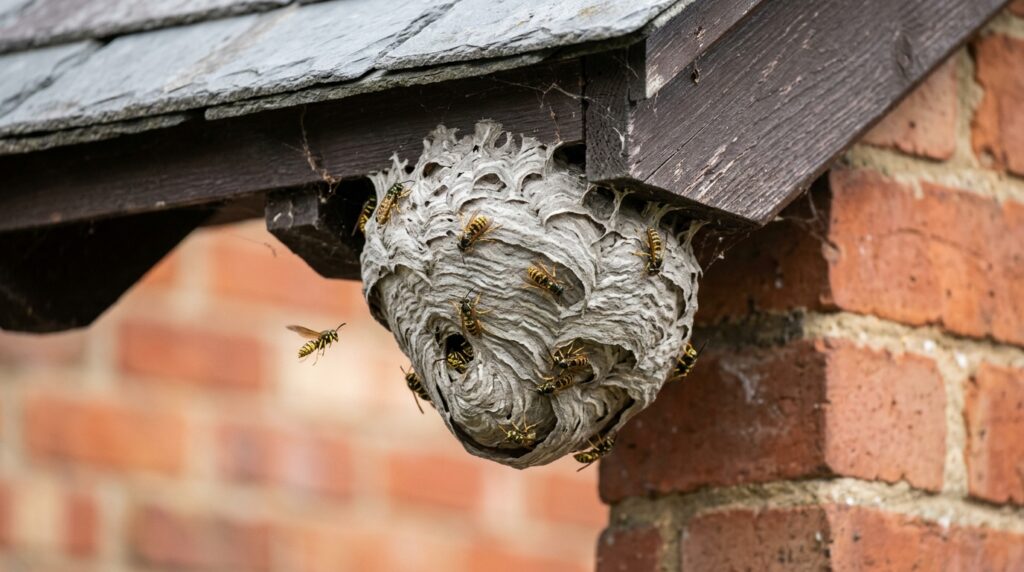
A wasp nest roughly a metre wide has taken over an office at a Norfolk Wildlife Trust site, building itself around a bookshelf of ring binders and leaving the reserve manager to work around her new lodgers, as reported by the Great Yarmouth Mercury. Stories like this cluster in August for a simple reason: this is the month UK wasp nests reach their maximum size. Here is why nests are at their biggest right now, when leaving one alone is a reasonable choice, and when it is not.

Key takeaways
- A metre-wide wasp nest was found built around a bookshelf in a Norfolk Wildlife Trust office, and the trust has chosen to let it stay until the colony dies off naturally.
- UK wasp colonies are founded by a single queen in spring and grow all summer, which is why nests found in August are so much larger than the ones spotted in June.
- Leaving a nest alone can make sense in a quiet, low-traffic spot - but not near doorways, lofts you use, gardens where children play, or any food business.
- Late summer is also when wasps become most persistent around people, as the colony winds down and workers switch to seeking sweet food.
- Never attempt to knock down, spray or block up an active nest yourself - disturbed wasps attack in numbers, and professional treatment is fast and safe.
What happened in Norfolk?
According to the Great Yarmouth Mercury, staff at the wildlife trust’s office at Ormesby St Michael discovered that wasps had constructed a nest around a metre wide around an office bookshelf. The trust took it in good humour, joking on social media that thousands of new colleagues had “moved in without permission, skipped recruitment entirely and ignored the office hot-desking policy”. The reserve manager told the paper she has been stung a number of times before and treats wasp nests with a lot of respect, but chose to leave this one in place because of the role wasps play in the ecosystem - keeping down leaf-eating insects such as aphids, pollinating, and providing food for birds and other wildlife. The colony will die off naturally as the weather cools, and wasps do not reuse old nests.
Why are wasp nests so big in August?
Every wasp nest in the UK starts the same way: a single queen emerges from hibernation in spring and builds a nest no bigger than a golf ball. Once her first workers hatch, they take over the building work and the queen concentrates on laying. The colony then grows continuously through the summer, and by August the nest is at or near its peak size - which is why the dramatic discoveries in lofts, sheds, wall cavities and, occasionally, offices almost always make the news at this time of year. A nest you could have dealt with in an afternoon in May is a very different proposition by late summer.
Is it ever OK to leave a wasp nest alone?
Sometimes, yes. Wasps are genuinely useful insects, and a nest high in a tree at the bottom of the garden, or in an undisturbed corner of a rarely used outbuilding, can often be left to run its course - the colony dies off in autumn and the nest is never used again. A wildlife trust with a quiet rural office and experienced staff making an informed choice to coexist is a good example of when that is a considered decision rather than a risk.
For most homes and businesses, though, the calculation is different. A nest near a doorway, window, loft hatch or garden seating area means regular close contact with defensive insects, and wasps sting repeatedly when they feel the nest is threatened. For anyone with an allergy, that is a serious medical risk. Late summer makes it worse: as the colony’s brood declines, workers abandon nest duties and go looking for sweet food, which is exactly when they become persistent around drinks, fruit and bins. And for food businesses there is no coexistence option at all - wasps around a kitchen or serving area are a hygiene and safety problem that needs dealing with promptly. If you are not sure what you are looking at, our guide to telling wasps and bees apart is a good place to start, because bees are treated very differently.
What should you do if you find a nest at home or work?
Do not attempt to remove it yourself. Knocking down, spraying or blocking the entrance of an active nest is the most common way people end up with multiple stings - the colony defends itself in numbers, and nests are often in awkward spots at height, which adds a fall risk on top. Our guide on how to deal with a wasp nest this summer covers what to avoid in more detail.
The safe route is professional treatment. Our wasp nest removal technicians are qualified to RSPH (BPCA) Level 2, treat nests quickly with the right protective equipment, and offer same-day appointments across the UK every day of the year except Christmas Day. JG Pest Control is rated 4.7 on Trustpilot with 27,000+ reviews. Call the number at the top of this page and we will get a technician to you fast.
Wasp nests in August: your questions answered
Far bigger than most people expect. The nest reported at the Norfolk Wildlife Trust office was around a metre wide. Colonies grow continuously from spring onwards, so a nest discovered in late summer is at or near its maximum size, with the greatest number of wasps inside that it will hold all year.
No. Once a colony dies off in autumn the nest is abandoned for good and is never reoccupied. New queens hibernate over winter and build a fresh nest from scratch in spring, sometimes near an old one but never inside it.
If the nest is well away from people - high in a tree, or in an outbuilding nobody uses - leaving it to die off naturally in autumn is often reasonable. If it is near a doorway, loft, garden seating area or any part of a business, or anyone nearby has a sting allergy, it should be professionally treated rather than left.
In autumn, as temperatures drop and food runs out. The workers and the old queen die off, while newly produced queens leave the nest to hibernate and start the cycle again the following spring. That is why the Norfolk Wildlife Trust can simply wait its unexpected office guests out.