
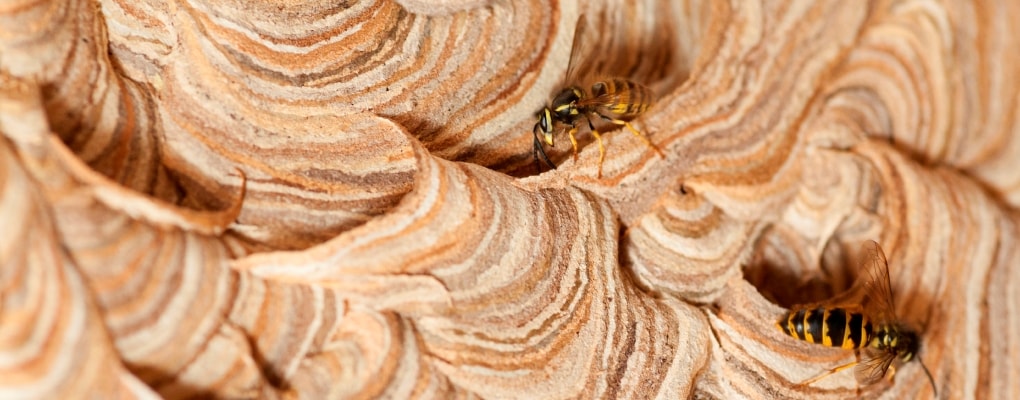
Wasps are slender with a narrow waist, smooth and shiny, and aggressively territorial. Bees are rounder, hairy, gentler and focused on flowers. If it’s slim and shiny with sharp colours, it’s a wasp. If it’s stocky and fuzzy, it’s a bee.

- Wasps sting repeatedly. Honey bees sting once and die.
- Wasp nests are papery grey/beige. Bee nests have wax comb.
- Wasps can be treated. JG always tries to safely relocate bees first.
Spotted a striped insect buzzing around the garden and wondering if it’s a wasp or a bee? The difference matters - wasps are aggressive pests and the nest should be removed promptly, while bees are valuable pollinators that we relocate rather than destroy wherever possible. Here is how to tell them apart confidently.
Wasp vs Bee at a Glance
| Feature | Wasp | Bee |
|---|---|---|
| Body shape | Slender with a clear narrow waist | Rounder, stockier, no obvious waist |
| Colour | Bright yellow with sharp black stripes | Honey bee: dull orange-brown. Bumble bee: black with yellow, white or orange bands |
| Texture | Smooth and shiny | Covered in fine hair (for pollen collection) |
| Behaviour around humans | Attracted to sweet food, sugary drinks, picnic meat | Focused on flowers and water; ignores humans |
| Sting | Stings repeatedly, no harm to itself | Honey bee dies after one sting (barbed stinger) |
| Nest material | Papery grey/beige (chewed wood and saliva) | Wax comb with golden hexagonal cells |
| Nest size | Up to 20,000 wasps at peak (depending on species) | Honey bee: 20,000-80,000. Bumble bee: a few hundred |
| JG’s approach | Treated and removed | Relocated to a beekeeper wherever possible |
Body Shape
This is the easiest visual difference and the one most people can see at a glance.
- Wasps are slender with a clear, narrow waist (the “wasp waist”). The body looks divided into two distinct sections.
- Bees are rounder, stockier, and the waist is much less pronounced. Bumble bees in particular look almost spherical.
Colouring
Both have yellow and black colouring, but the shade is different.
- Wasps: bright yellow with sharp black stripes. The colours are vivid and “clean.”
- Honey bees: duller orange-brown and black or grey. Less contrast than wasps.
- Bumble bees: often black with bands of yellow, orange or white. Some species have a white “tail.”
Behaviour Around You
Wasps and bees behave very differently around humans.
- Wasps are attracted to sweet food, sugary drinks, meat scraps and protein. They will hover near picnics and bins. Late summer is when they become most aggressive as food sources dwindle.
- Bees are focused on flowers and water. They generally ignore humans unless directly threatened or near their hive.
The Nest
If you can see the nest itself, identification is straightforward.
- Wasp nests are made of chewed wood mixed with saliva - papery, grey or beige, with visible hexagonal cells if exposed. Common in lofts, sheds and wall cavities. A mature nest can hold up to 20,000 wasps, depending on the species.
- Honey bee nests contain wax comb - golden-yellow, structured cells full of honey and brood. Usually in cavity walls, chimneys or hollow trees. A colony has 20,000-80,000 bees.
- Bumble bee nests are small (a few hundred bees), often in compost heaps, garden sheds or bird boxes. The colony lasts only one summer.
The Sting
A practical difference if you have been stung:
- Wasps can sting repeatedly without harm to themselves. They retain their stinger and can attack multiple times.
- Honey bees have barbed stingers that lodge in the skin. The bee dies after stinging. If you find a stinger left in the skin, it was a bee.
- Bumble bees can sting more than once but rarely do - they are very gentle unless their nest is threatened.
What to Do Next
If you have wasps, see our wasp nest removal service for same-day removal, or read up on UK wasp species for more identification detail.
If you have bees, our bee nest removal team will always attempt relocation rather than destruction. Read the about bees guide for our ethical removal process.
If you are unsure, our RSPH (BPCA) Level 2 certified and trained techs can identify the insect during a free survey call. Don’t attempt to disturb the nest yourself - both wasps and bees can mobilise rapidly when threatened.
Frequently Asked Questions
Are bees protected by law in the UK?
Bees are not legally protected as a species in the UK - that’s a common misconception. However, JG always attempts relocation rather than destruction because of their ecological value. Wasps have no such ethical consideration.
Should I remove a wasp nest myself?
Never. Wasps release alarm pheromones when threatened, which can trigger mass stinging within seconds. The chemicals available to the public are also weaker than professional alternatives, so DIY attempts often half-treat the nest and leave hundreds of angry survivors.
How can I tell if it’s a queen wasp in spring?
Queen wasps are visibly larger than worker wasps (15-20mm vs 10-15mm) and appear in spring on their own as they emerge from hibernation. A single large wasp in spring is usually a queen looking to start a nest - not a sign of an active nest in your home.
What’s the difference between a hornet and a wasp?
Hornets are a type of wasp - just larger. UK hornets are 25-35mm with brown markings. They are surprisingly less aggressive than common wasps and aren’t attracted to human food. But they will mobilise the whole nest if threatened, and the sting is more painful.
When does wasp activity peak in the UK?
Wasps become most aggressive in late August and September, when the nest’s larvae stop producing the sugary secretion that workers feed on. Workers then go looking for sugar elsewhere - which is when they descend on picnics, bins and beer gardens. By late autumn the nest dies off.