
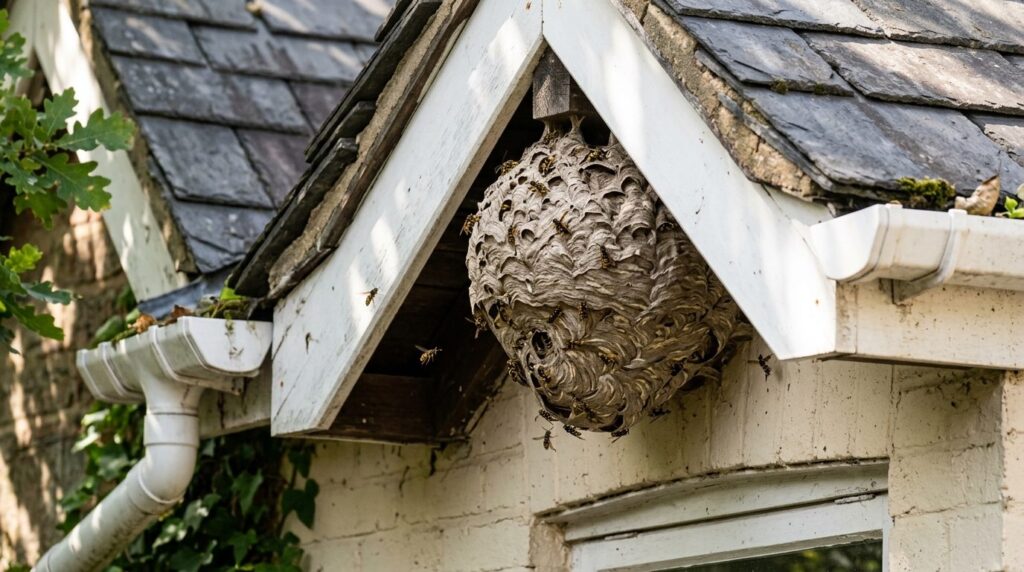
As the British summer arrives and we spend more time enjoying our gardens, we also welcome some less invited guests. Wasps become highly active during the warmer months, often building nests in lofts, sheds, cavity walls, and under roof eaves. While a single wasp is a minor nuisance, a fully established nest close to your home can present a genuine hazard to your family and pets.

Understanding the seasonal patterns of these insects helps explain why they suddenly seem to appear in such large quantities. Our wasp callouts climbed from 17 in the first week of March to 378 by early July 2026, a 22-fold seasonal rise. This rapid increase highlights just how quickly a small, unnoticed queen wasp starting a nest in spring can turn into a bustling colony by midsummer.
How to identify a wasp nest
Before taking action, it is important to confirm that you are dealing with wasps rather than honeybees or hornets. Wasps are characterised by their distinct yellow and black stripes and a narrow waist. Their nests are constructed from chewed wood mixed with saliva, which gives them a distinctive grey, papery appearance.
During the summer, you might not see the nest itself if it is tucked away inside a wall cavity or high up in the roof space. Instead, you will notice a continuous stream of wasps flying in and out of a single entrance point, such as a gap in the brickwork, a fascia board, or a garden shed door. If you spot this high volume of insect traffic, a nest is almost certainly present nearby.
The dangers of DIY wasp nest removal
It can be tempting to try and tackle a wasp nest yourself using shop-bought sprays or traditional home remedies. However, attempting to remove or destroy a nest without professional equipment is highly risky. When a wasp nest is threatened, the insects release distress pheromones that signal the rest of the colony to attack. Unlike bees, a single wasp can sting multiple times, and an angry swarm can quickly overwhelm an unprotected individual.
To keep your household safe, consider the following precautions:
- Keep your distance: Never approach an active nest or attempt to poke it with sticks or ladders.
- Secure your home: Keep windows and doors closed if you suspect a nest is located near an entry point.
- Manage food waste: Ensure outdoor bins have tight-fitting lids, as sweet foods and rubbish attract foraging wasps.
- Protect children and pets: Keep them away from the suspected area until the issue is resolved.
Why professional help is essential
Dealing with a wasp nest safely requires specialised protective gear and professional-grade treatments that are not available to the general public. Professional pest controllers can quickly neutralise the nest from a safe distance, minimising the risk of stings to residents and neighbours.
When choosing a technician, you should always look for qualified experts. At JG Pest Control, our technicians hold the RSPH (BPCA) Level 2 qualification, ensuring that all treatments are carried out safely, humanely, and in accordance with strict industry standards. We understand the urgency of a wasp infestation, especially during the peak of summer, and we focus on delivering a swift, reliable service.
As a leading provider in the UK, JG Pest Control is the highest rated pest control company on Trustpilot, 4.7 out of 5 from more than 28,000 reviews. This reputation is built on our commitment to effective solutions and outstanding customer care.
Get in touch today
If you have spotted signs of a wasp nest in your home or garden, do not risk dealing with it yourself. Our professional team is ready to help restore peace and safety to your outdoor spaces. Please visit our website to get in touch or book online today.