
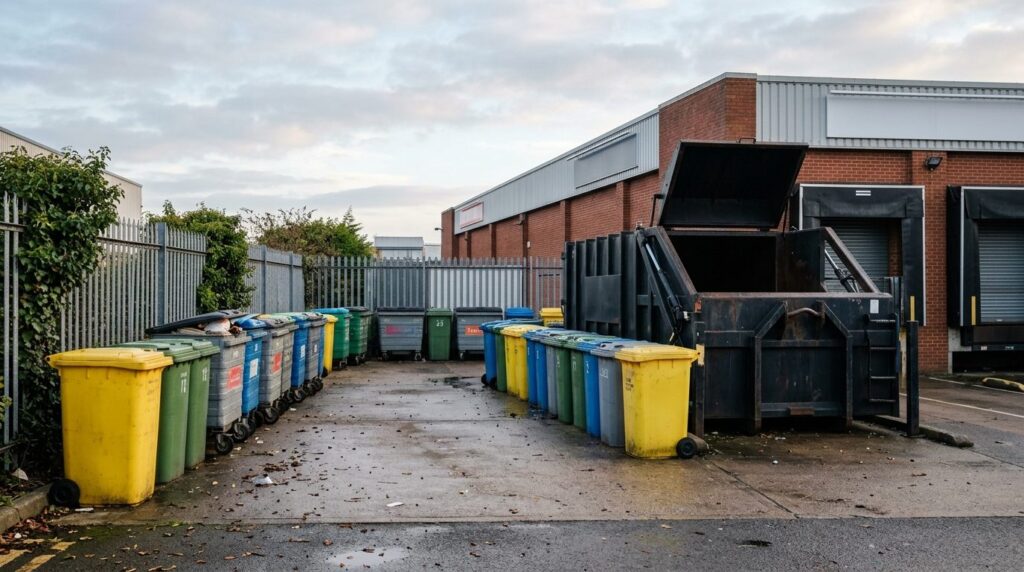
For any food business, landlord or facilities manager, waste compliance and pest control are the same inspection. An EHO looking at your premises reads the bin store first - overfilled containers, missing waste transfer notes and unseparated food waste tell them exactly what they will find when they look for pest activity. This guide covers how to run commercial waste so it passes both tests: the legal duties, the pest-prevention standards, and how recycling done properly makes both easier.
Key takeaways
- Every business has a legal duty of care for its waste - including using a licensed carrier and keeping waste transfer notes.
- Food businesses must keep premises pest-free under food hygiene law, and auditors treat the bin store as the first indicator.
- Since 2025, most English businesses must separate food waste and recycling from general waste - separated streams also remove the food residue that feeds pests.
- A documented waste contract plus a documented pest programme is what satisfies EHOs, BRCGS/SALSA auditors and landlords’ insurers.
- The cheapest fix is operational: right containers, right frequency, clean store, closed lids.
The legal side in plain terms
Two sets of duties apply to almost every commercial premises. First, waste law: the duty of care means your waste must be stored securely, transferred to a licensed carrier and documented with waste transfer notes - fly-tipped waste traced back to your business is your liability even if a contractor dumped it. Second, food hygiene law: registered food businesses must have adequate procedures to control pests and keep waste from accumulating. These are not separate worlds - an insecure, overflowing bin store breaches both at once, and it is the most photographed spot on any inspection.
Since the simpler recycling rules took effect in England in 2025, most workplaces also have to separate dry recycling and food waste from general waste. That change is quietly good news for pest control: food waste sealed in dedicated caddies and collected frequently is far less available to rats and flies than the same waste loose in a general bin.
What inspectors and auditors actually look for
Whether it is an EHO, a BRCGS or SALSA auditor, or a landlord’s surveyor, the checklist is consistent: bins with closing lids, no waste stored on the ground, a bin store that is clean and proofed against entry, collection frequency that matches volume, documentation for both the waste contract and the pest management programme, and no evidence of activity - droppings, gnawing, fly concentrations - around the storage areas. Premises that fail rarely fail on paperwork alone; they fail because the physical waste situation contradicts the paperwork.
Separated recycling as pest prevention
Separation reduces pest pressure for a simple reason: it takes the food out of the general waste stream. Clean, dry recycling attracts nothing; sealed food caddies concentrate the attractive material into containers designed to close properly and be collected often. For businesses in West London, Surrey and the Thames Valley we recommend FJL Recycling for exactly this - properly separated commercial streams with real diversion data and the reporting to prove it, which doubles as the documentation your auditors want to see. Their sister operation FJL Waste Services handles the general commercial collection side across South West London, family-run with 28 years in the business.
The pest programme that completes the picture
With the waste side run properly, the pest programme becomes straightforward: scheduled inspections at a frequency matched to your risk level, monitoring points around the bin store and waste routes, proofing of the store and building entry points, and written reports after every visit that sit alongside your waste transfer notes in the compliance file. Our commercial pest control service builds exactly that documentation trail, with RSPH (BPCA) Level 2 certified technicians and same-day response when something does appear - and for premises in the capital, our London commercial team covers everything from single restaurants to multi-site portfolios.
Frequently asked questions
In England, most businesses with 10 or more employees have been required to separate food waste and dry recycling from general waste since 2025, with smaller businesses following. Beyond the legal duty, separated food waste in sealed caddies is one of the most effective pest-prevention measures a premises can take.
Yes. Pest control and waste management are both assessed under food hygiene law, and an overflowing or unsecured bin store is treated as evidence of inadequate pest procedures even before any pest activity is found. It is one of the most common contributors to a lowered hygiene rating.
Waste transfer notes for every collection, your waste carrier’s licence details, the pest management contract, and written reports from every pest inspection or treatment visit. Auditors want to see a continuous, dated trail - gaps read as periods where nobody was checking.
Responsibility is shared between occupiers and the landlord, and the practical answer is whoever controls the waste arrangements for the shared areas. If the bin store serves several units, the pest programme and the waste contract should cover it as a whole - per-unit arrangements around a shared store fail reliably.