
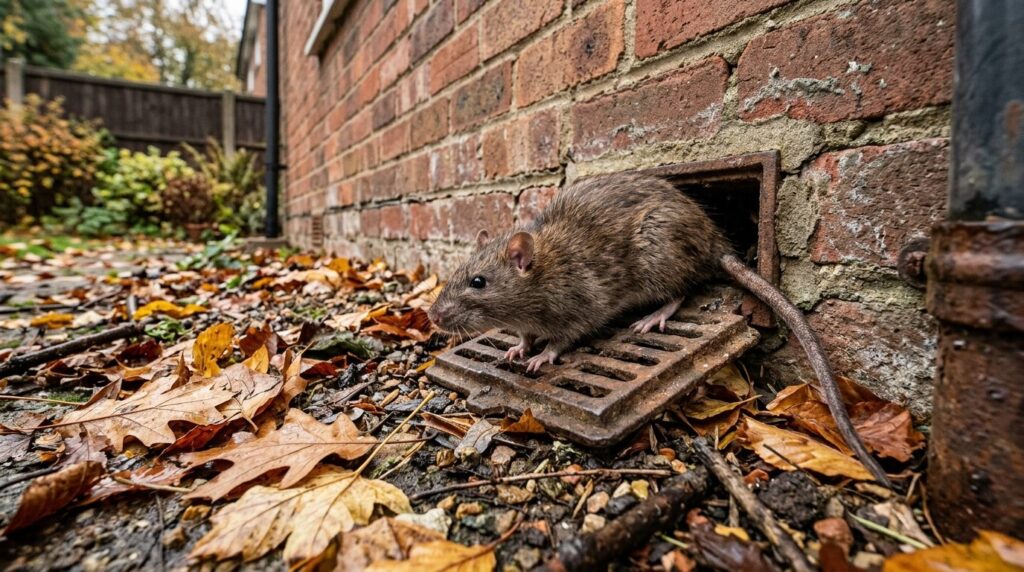
If your council no longer treats rats, its legal duty over them has not gone anywhere. Withdrawing a paid treatment service and withdrawing responsibility are two different things, and a lot of households do not realise the second has not happened. Under the Prevention of Damage by Pests Act 1949 every local authority in England, Wales and Scotland still has a standing duty to keep its district free of rats and mice so far as is practicable, whether or not it runs a van that turns up at your door. What changes when a service is cut is the route you take, not whether you have one.

The question is live again this week. The Yorkshire Post reported on 17 September 2026 that a councillor had asked Calderdale Council’s September Cabinet meeting to bring back the pest control service whose withdrawal was announced in October 2023 and phased out over the following months, saying rat infestations were on the rise. The Yorkshire Post reports that the council’s own website confirms the service is no longer offered. A cabinet member responded that the decision to scrap it was “at best short sighted” and that vermin were now an issue, and members agreed the options would be explored.
Key takeaways
- Calderdale Council’s pest control service withdrawal was announced in October 2023 and phased out over the following months, and its website confirms it is no longer offered, according to the Yorkshire Post on 17 September 2026.
- Cutting a treatment service does not cut the statutory duty. Section 2 of the Prevention of Damage by Pests Act 1949 requires every local authority to keep its district free from rats and mice so far as practicable.
- Councils that no longer treat still hold enforcement powers. Section 4 of the same Act lets a council require an owner or occupier to take action.
- If rats are living on or resorting to your land in substantial numbers, section 3 obliges you as occupier to notify the council in writing, and failing to do so is a summary offence.
- Where the rats are coming from someone else’s land, reporting it to the council is still the correct first move even in an area with no treatment service.
- Renting changes who pays. Repairing and fitness obligations usually put the structural side of a rodent problem with the landlord, not the tenant.
- An outdoor rat population that keeps coming back is almost always a drainage or harbourage problem, so treatment alone will not hold.
What does it actually mean when a council stops doing pest control?
It means the council has stopped selling you a treatment. It does not mean rats have become purely your problem.
Where councils have withdrawn, it is generally the domestic treatment service that goes, the part where an officer attends a house and lays bait. That was usually a chargeable service, and one that often did not cover its costs. What sits underneath it is statutory and cannot be withdrawn by a budget decision. Section 2 of the Prevention of Damage by Pests Act 1949 puts a duty on every local authority to take such steps as may be necessary to secure, so far as practicable, that their district is kept free from rats and mice. It also requires them to carry out inspections, to deal with rodents on land they occupy themselves, and to enforce the obligations the Act places on other owners and occupiers.
That last limb is the one people miss. A council with no treatment service still has the power under section 4 to require an owner or occupier to take action. So if the source of the problem is a neighbouring commercial yard, a derelict property, a fly-tipped plot or a badly run bin store, the council remains the body with the power to require action. Reporting it is not a waste of time just because nobody will come and bait your loft.
Who is responsible for the rats, and when does that shift?
The short version is that responsibility follows the land, and it is worth being clear about which land is in play.
If rats are established on ground you own and occupy, treatment is yours to arrange. If you occupy the land and the numbers are significant, the Act actually places a duty on you rather than an option. Section 3 requires the occupier of any land to give the local authority notice in writing, forthwith, if it comes to their knowledge that rats or mice are living on or resorting to the land in substantial numbers. Agricultural land is treated separately. Failing to give that notice is a summary offence. This obligation is not widely known, but it tells you something about the shape of the law: the system is built around the council knowing where the rats are, which only works if people report.
If you rent, the picture is different again. The structural side of a rodent problem, the defective drain, the broken airbrick, the gaps around service runs, generally falls within a landlord’s repairing and fitness obligations rather than the tenant’s. We have set out how that works in more detail on our landlord and letting agent pest control page. In a housing association or council-owned block the landlord side is usually handled through a planned contract, which is covered on our social housing pest control page. Tenants in that position should be raising a repair report, not buying bait.
Why do rat numbers rise after a service is withdrawn?
Because the gap between a problem starting and something being done about it gets longer, and rats are very good at using that time.
A brown rat can breed from around three months old and a female can produce several litters a year, so a population that is left alone for a season does not stay the same size. When a free or low-cost council service exists, a lot of small domestic problems get dealt with early, at the point where one household notices droppings under a kitchen unit. Take that away and a proportion of those households do nothing at all, a proportion buy a box of bait from a hardware shop and use it badly, and only some call a professional. The first two groups are where populations build.
There is a second effect that matters more at street level. Rat problems on residential estates are rarely confined to one address. If the population is living outdoors in shrub beds, under decking or in a defective drain run, treating one garden while the neighbouring three do nothing will not reduce it. Co-ordinated treatment across a block is exactly the kind of thing a council service used to deliver almost by accident, simply by attending several addresses in the same street. Without it, treatment fragments.
The signal to watch for is daytime activity. Rats forage at dusk and overnight by preference, so animals moving openly in daylight usually mean the population has outgrown its cover and its night-time feeding window. We have written separately on what daytime rat sightings really mean.
What should you actually do if your council no longer treats?
Report it anyway, then deal with the cause rather than just the animals.
Reporting matters for two reasons. It is how the council meets its inspection duty, and it is how a source you do not control comes to its attention. Check what your own authority offers rather than assuming, because provision varies widely between neighbouring districts. Many that have withdrawn treatment still run an online pest report form, and some still attend where there is a public health risk, a commercial source or council-owned land involved.
Then look at the three things that actually sustain an outdoor population. Harbourage, meaning dense ground cover, ivy, decking, stacked material and overgrown boundaries. Drainage, meaning cracked runs, displaced covers, redundant capped pipes and broken gullies that connect the surface to the sewer. And food, meaning bins that do not close, fly-tipping and ground-feeding for birds. Baiting without addressing those is temporary by definition, because a sewer population is effectively unlimited and will simply refill the space.
On DIY, the honest advice is to be careful. Amateur rodenticides are heavily restricted in how they may be used, they are a genuine hazard around children, pets and wildlife, and poorly placed bait in a shared outdoor space is both unsafe and, in most tenancies, not yours to place. If you are not sure what you are looking at, our rat identification and risks guide covers the signs, and our rat control service page explains how a professional treatment is structured.
Is this likely to spread to other councils?
The direction of travel has been one way for some years, and Calderdale is one example rather than an outlier.
Domestic pest treatment is a discretionary service sitting next to statutory ones in a squeezed budget, so it is a recurring candidate for withdrawal or for a charge that rises until demand falls away. What the Calderdale debate reported by the Yorkshire Post shows is the other half of the cycle: once the service has gone and rodent complaints are raised, the question of bringing it back arrives at cabinet. Whether it returns there is a matter for that council, and no decision was taken at the meeting beyond agreeing to explore the options.
For households and businesses the practical position is unchanged in the meantime. The duty on the council persists, the obligation on occupiers to report persists, and the work of actually clearing an established population still needs doing properly.
Frequently asked questions
Your council has a duty under section 2 of the Prevention of Damage by Pests Act 1949 to take such steps as may be necessary to keep its district free from rats and mice so far as practicable, and to enforce the Act’s obligations on owners and occupiers. That is not the same as a duty to treat your house for free. Many councils meet the duty through inspection, enforcement and work on their own land while charging for, or no longer offering, domestic treatment.
If you are the occupier of the land and rats or mice are living on or resorting to it in substantial numbers, section 3 of the Act requires you to notify the local authority in writing without delay. Agricultural land is dealt with separately. Failing to give that notice is a summary offence, although in practice enforcement against householders is rare.
It depends on the cause. Where the problem stems from the condition of the building, for example a defective drain, a broken airbrick or gaps around service pipes, it will usually fall within the landlord’s repairing and fitness obligations. Where it stems from how the property is being used, for example waste management inside the home, it is more likely to sit with the tenant. Report it to the landlord or managing agent in writing either way, because that record matters.
You can buy amateur-use products, but they are restricted in how they may be used and they are a real risk to children, pets and wildlife if placed badly. They also do nothing about the drain defect or the harbourage that is sustaining the population, which is why DIY treatment so often appears to work and then fails a few weeks later. For an established or outdoor infestation, a surveyed professional treatment is the more reliable route.
How JG can help
JG Pest Control works across the UK and our technicians are qualified to RSPH (BPCA) Level 2. We respond within 24 hours every day of the year except Christmas Day, and our surveys look for the drainage and harbourage causes behind a rat problem rather than just treating the animals present. To arrange a survey, call the number at the top of the page or use the enquiry form.
Source: Yorkshire Post, “Call to bring back council pest control as rats on the rise in Calderdale”, 17 September 2026. Statutory references are to the Prevention of Damage by Pests Act 1949.