
Renting out property in the UK comes with a long list of responsibilities, and pest control is one that catches many landlords and letting agents off guard. A single mouse sighting in a let flat can quickly turn into a dispute over who pays, a disrepair complaint, or a one-star review that follows an agency around a whole town. JG Pest Control has worked with private landlords, portfolio investors, managing agents and block management companies since 2010, and in over 15 years we have learned that the tenants who feel looked after stay longer, pay on time and leave the place in good order. Our RSPH (BPCA) Level 2 certified technicians treat rented homes discreetly, document everything, and give you the paper trail you need to protect deposits, tenancies and your reputation.
Who is responsible for pest control - landlord or tenant?
This is the question we are asked more than any other, and the honest answer is that it depends on the cause. As general guidance rather than legal advice, responsibility usually falls to the landlord where the infestation stems from something structural or a state of disrepair - gaps around pipework, broken airbricks, a damaged roofline, or an issue in shared and communal areas that no single tenant controls. Where an infestation is clearly caused by a tenant’s own actions, such as poor waste habits, the position can shift. The cleanest approach is to set out expectations in the tenancy agreement and to confirm who is liable there before a problem arises, so nobody is arguing about it with mice in the kitchen.
It is worth remembering the wider legal backdrop. Under the Homes (Fitness for Human Habitation) Act 2018, rented homes must be fit to live in, and the Housing Health and Safety Rating System (HHSRS) treats a rodent infestation as a potential Category hazard. If a tenant reports pests to the local authority and the council inspects, enforcement action can follow. Acting quickly is almost always cheaper and calmer than waiting for an environmental health officer to knock on the door.
HMOs and blocks of flats - why treating one unit is never enough
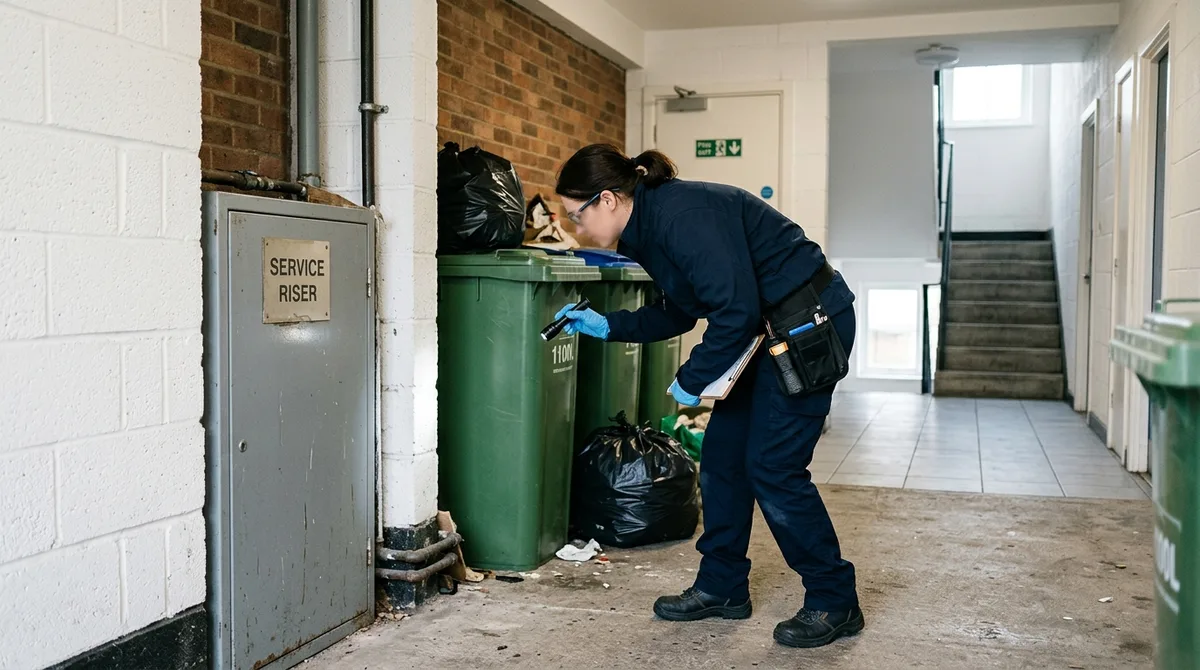
Houses in multiple occupation and blocks of flats are the hardest lettings environments to keep pest-free, because pests do not respect the boundaries of a tenancy. Mice, rats, cockroaches and bed bugs move between units through shared voids, riser cupboards, cavity walls, suspended ceilings and service ducts. Treating the flat that complained while leaving the neighbours untouched simply pushes the problem next door, and it comes straight back. Our approach for HMOs and blocks is to survey the whole building, identify the harbourage and the routes between units, and treat the property as one connected system.
- Communal bin stores - a major rodent draw in blocks, and a frequent trigger for HHSRS complaints.
- Shared voids and risers - the motorways pests use to travel unseen between flats.
- HMO licensing - documented pest management supports the conditions many councils attach to a licence.
- Turnover of occupants - high tenant churn in HMOs makes proactive monitoring far safer than reacting to each report.
Bed bugs, void periods and the gap between tenancies
Bed bugs are the classic lettings headache. They spread between tenancies, hitch a ride on second-hand furniture, and travel between adjoining flats through skirting and sockets. The safest moment to deal with them, and with any infestation, is during the void period between tenancies when the property is empty. A void is your window to inspect, treat and confirm clearance before new keys are handed over, and it is the last time you will have unrestricted access without disturbing anyone. We work to fast turnarounds so a treatment does not hold up a check-in, offering same-day emergency callouts when a void is tight or a new tenant has already reported a problem.
Portfolio and block management - one arrangement, not endless panic callouts
For letting agents and managing agents juggling dozens or hundreds of doors, one-off emergency callouts are the worst way to handle pests. They are unpredictable, they generate awkward conversations with tenants, and they leave no consistent record. A documented, portfolio-wide arrangement gives you a single point of contact, planned monitoring at higher-risk properties, and a clear audit trail for every visit. That paperwork matters when you are defending a deposit deduction, responding to a disrepair claim, or demonstrating to a council that you took reasonable steps promptly. We are happy to coordinate directly with tenants to arrange access, so your team is not stuck playing messenger.
Why landlords and agents choose JG Pest Control
We are rated 4.7 out of 5 from over 25,000 reviews, the highest rated pest control company on Trustpilot, and our RSPH (BPCA) Level 2 certified technicians are available every day except Christmas Day, from early until late, including weekends and bank holidays. Every visit comes with a free, no-obligation site survey and guaranteed treatments, plus the documentation lettings professionals need. Whether you own one buy-to-let or manage a portfolio of blocks, we help you stay compliant, protect your deposits and keep tenants happy.
Book your free landlord pest survey today
Protect your properties, your tenancies and your reviews. Get in touch to speak to our team, or use the enquiry form on the website to arrange a free, no-obligation survey at a time that suits your tenants and your void schedule.