
Small bees disappearing into holes in your mortar, airbricks or window frames in spring are almost certainly masonry bees - also called mortar bees or red mason bees - and the honest news is they are usually harmless. They are solitary, virtually never sting, and in most homes need pointing work rather than pest control. JG Pest Control will tell you which applies to your property - we are open every day except Christmas Day, early until late.
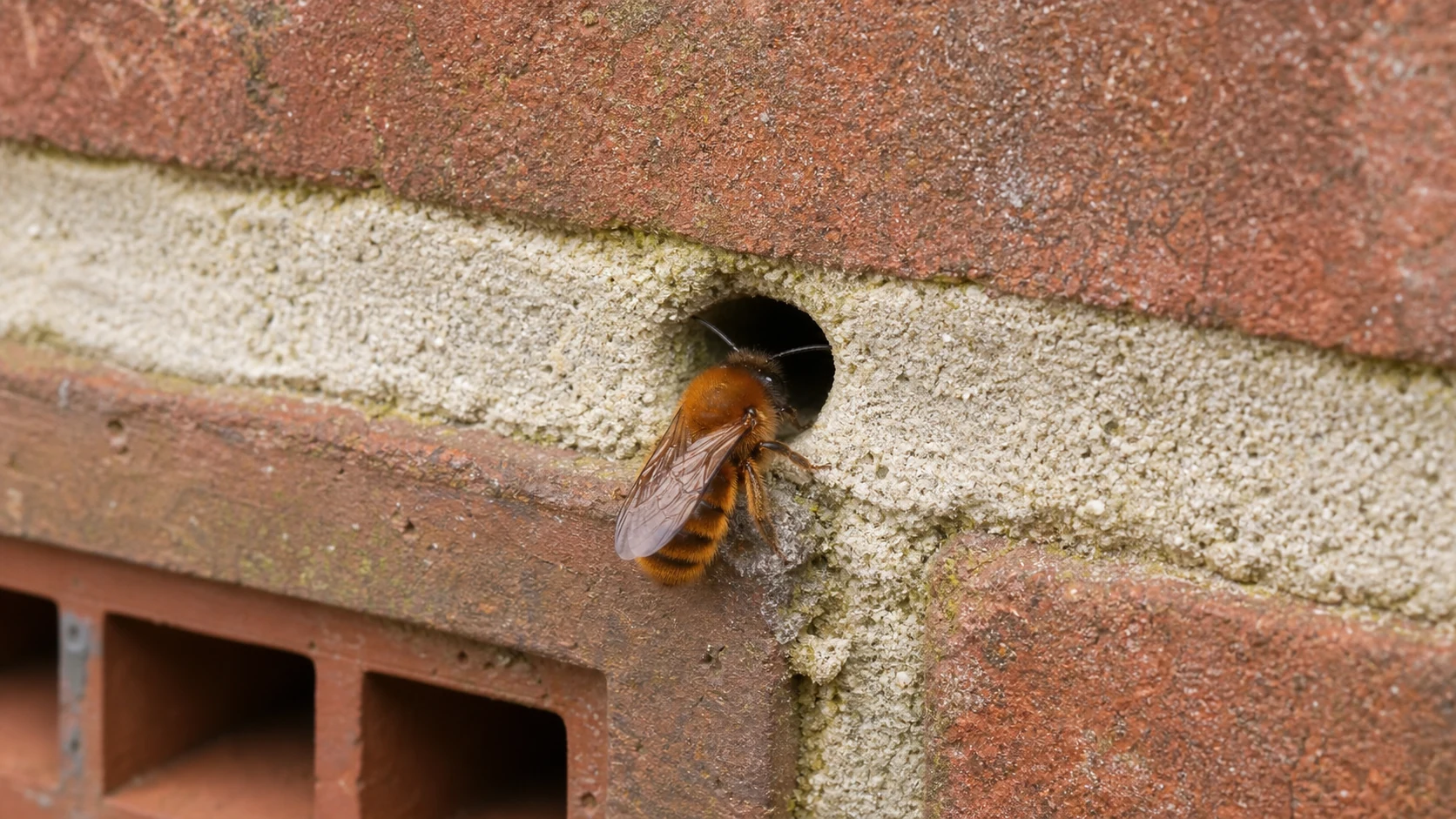
What are masonry bees?
Masonry bee (or mortar bee) is the everyday name for several species of solitary bee - most often the red mason bee - that nest in small cavities: soft or crumbling mortar joints, airbricks, drilled holes, window frames and occasionally cob or soft brick itself. Mining bees are close relatives that do the same thing in lawns and bare soil, leaving little volcano-shaped mounds.
Unlike honey bees or wasps there is no colony and no shared nest to defend. Each female works alone, stocking a few cells with pollen for her young. What looks like “a swarm going into the wall” in April and May is usually many individual bees using the same warm, south-facing patch of brickwork.
Are masonry bees a problem?
-
Stings
females can technically sting but almost never do; males cannot sting at all. They are safe around children and pets.
-
Damage
masonry bees exploit mortar that is already soft or failing rather than tunnelling through sound walls. A few bees are cosmetic; large aggregations returning year after year can gradually enlarge holes in already-weak joints.
-
Pollination
mason and mining bees are superb pollinators, which is why we always look for a live-and-let-live answer first.
What we recommend
For most homes: nothing, or building work rather than treatment. The bees fly for a few weeks in spring, do their pollinating, and are gone by early summer. The lasting fix for recurring activity is repointing the affected wall in autumn or winter (when the bees have finished), upgrading airbricks to fine-mesh versions, and filling redundant holes. Treating the bees without fixing the mortar just leaves the same front door open for next spring.
Where activity is genuinely heavy, recurring and damaging - or where someone in the household is allergic - our technicians can survey the wall, confirm the species and agree a proportionate plan. If what you actually have turns out to be bumblebees, honey bees or a wasp nest, we will identify that and deal with it appropriately. Every visit is by an RSPH (BPCA) Level 2 certified and trained technician.
Frequently asked questions
They exploit mortar that is already soft rather than boring through sound walls. Small numbers are harmless; large aggregations over several years can enlarge existing weaknesses, which is fixed by repointing once the season ends.
Hardly ever. They are solitary, with no colony to defend - females can sting but are extremely reluctant, and males cannot sting at all.
Wait for the spring flight season to finish, then repoint the joints and mesh the airbricks - that removes the nesting sites permanently. Treating the bees themselves is rarely needed and we will say so when that is the case.
Those are mining bees - the ground-nesting cousins. Same story: solitary, docile, active for a few weeks, excellent pollinators, and very rarely worth treating.
Masonry bees are small, gingery and fly in and out of many separate holes. Wasps and honey bees stream in and out of one entrance in numbers. Send us a photo if you are unsure - identification advice is free.