02031 310 988
Credit Cards
Lines Open: until 8:00pm
enquiries@jgpestcontrol.co.uk
Email or Callback

Enter your details below to request a call back and we will get back in touch as soon as possible.

Get in touch today for a
FREE INSTANT QUOTE...

Expert Pest Control
24 Hour Emergency Response
Get Free Quote
Mon 1st
The Pest Control Professionals.
Professionally Trained

All our employees are professionally trained to industry standards

Value For Money

We provide the best services in the industry at value for money

Customer Protection

All services guaranteed, providing you protection going forwards

Professionally Trained Staff

Best Services in the Industry
All Services 100% Guaranteed

Bristol wasp nest removal demand climbs sharply from late June and peaks hard through July, August and into early September, with the bulk of the workload arising from common wasp (Vespula vulgaris) and German wasp (Vespula germanica) nests in lofts, soffit voids, sheds, garages and wall cavities across the city’s residential belt. The period housing of Clifton, Redland and Cotham carries a heavy share of eaves and soffit nest work, the large gardens of Stoke Bishop and Sneyd Park produce a steady stream of garden and tree wasp callouts, the dense Bedminster and Southville terraces drive the cavity-wall workload, and the Harbourside and Park Street hospitality belt sees the highest foraging pressure of the year through August. JG Pest Control’s wasp nest removal in Bristol is same-day, fully equipped and never DIY. RSPH (BPCA) Level 2 certified and trainee technicians.

Call our Bristol wasp team: 0117 266 0010

Same-day callout across BS postcodes. Treat the nest, removed where access permits, written guarantee.

We cover every Bristol postcode from BS1 through BS16 plus the wider catchment across South Gloucestershire, Bath and North East Somerset and North Somerset including Portishead, Clevedon, Nailsea, Keynsham and Yate. Most summer wasp jobs are reached the same day. Out of hours rolls to our national line on 0330 053 9002. We are open early mornings, late evenings, every weekend and every UK bank holiday except Christmas Day, which matters because Bristol wasp callouts spike hardest on Saturdays and Sundays through the school holidays and the August bank holiday weekend.

Find out if we provide pest control near you:

Why wasp nests never qualify as a DIY job

The single most important fact about wasp nest removal is the anaphylaxis risk. A common wasp sting delivers a venom complex that triggers severe systemic allergic reaction in roughly one in 200 adults, and each prior sting builds immune sensitisation. A defensive colony reacting to nest disturbance produces dozens of simultaneous stings, and the swarm pursues the disturber for several hundred metres. A loft-ladder fall during a panic retreat from a disturbed nest is a separate and frequent injury route, particularly across Bristol’s older Clifton and Redland housing where loft access is often via narrow steep ladders. Supermarket aerosol wasp killer does not penetrate the nest fabric and even where the spray reaches the entry hole the disturbed colony will defend rather than die. Professional wasp nest removal uses pyrethrum-based insecticide dust applied directly into the nest entry through a long-reach lance. The dust is carried into the nest core by returning workers, killing the colony within four to twenty four hours.

For same-day wasp nest removal anywhere in Bristol, call 0117 266 0010 or request a callback.

When wasps are worst in Bristol

The Bristol wasp season runs from the last week of June through to early October, with a clear peak in August. Knowing what stage of the season you are in tells you what kind of nest you are dealing with and how quickly it needs treating.

Period What is happening in Bristol wasp nests
Late June Queens have finished founding nests. First batches of workers emerging. Nests still small, golf ball to tennis ball size, mostly hidden in lofts and soffit voids across Clifton, Redland and the Bristol suburban belt.
July Worker numbers climb steeply. Nests reach grapefruit to football size. Loft and eaves entry holes show heavy daylight traffic. First clear visual sighting for many households.
August (peak) Mature nests with 3,000 to 6,000 workers. Maximum daylight traffic. Foraging pressure across Harbourside, Park Street and the Bristol hospitality belt reaches its peak alongside garden callouts across Stoke Bishop, Westbury and Bedminster.
September (aggression peak) Colony stops producing brood. Workers switch from larval feeding to scavenging sugar. Wasps become aggressively interested in beer gardens, picnics and bin areas. Sting incidents peak.
Early October Nests in decline. Workers dying off. Most nests naturally end with the first hard frosts, but a mature nest left to its own devices can still produce hundreds of new queens that overwinter in lofts and outbuildings for next year.

Wasp species we treat across Bristol

Common wasp (Vespula vulgaris)

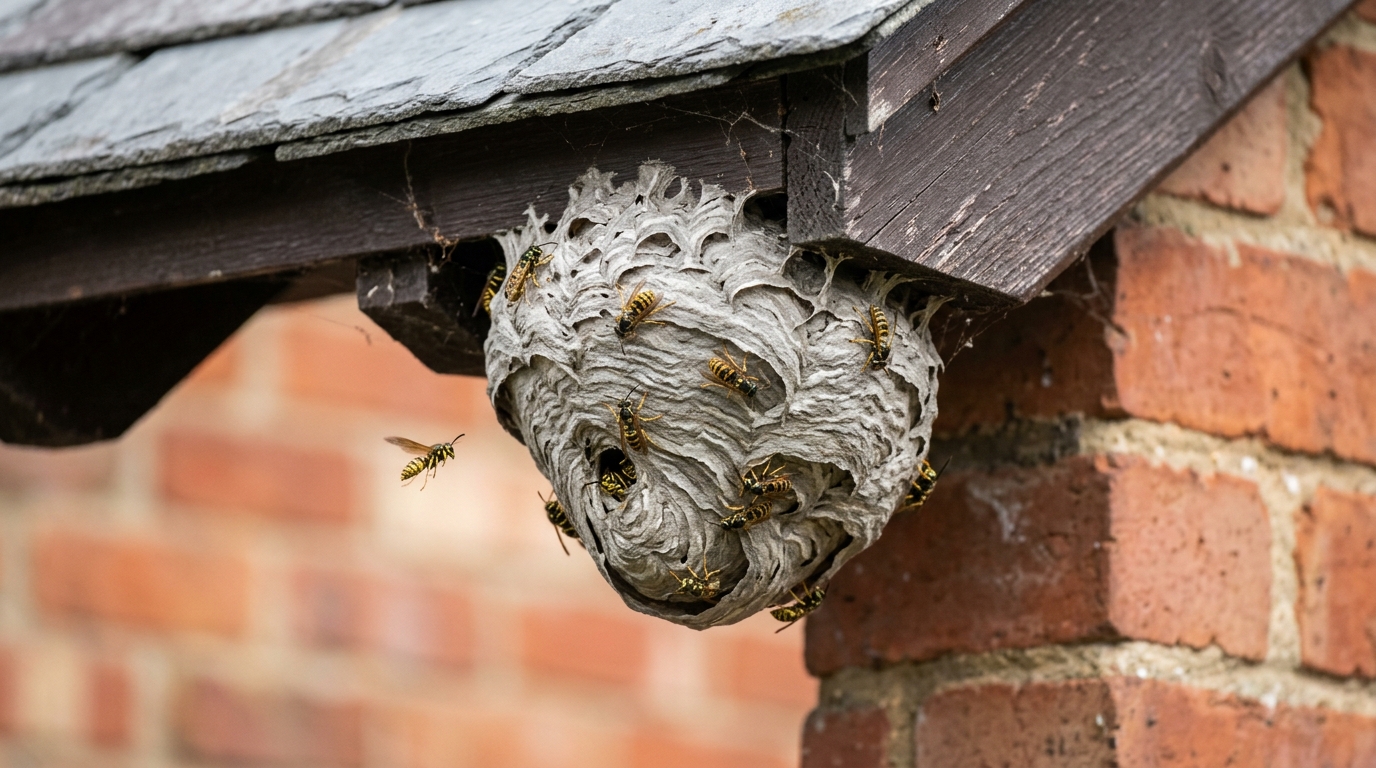
The species behind the vast majority of Bristol summer wasp calls. Nests in lofts, sheds, garages, wall cavities and underground in garden banks. Grey papery wood pulp nest material. A mature nest at peak season contains 3,000 to 6,000 workers.

German wasp (Vespula germanica)

Slightly larger, slightly more aggressive than the common wasp. Same nest types and same treatment approach. Frequent across Bristol urban settings, often nesting in cavity walls and soffit voids of Victorian and Edwardian terraced housing across Bedminster, Southville and Easton.

Tree wasp (Dolichovespula sylvestris)

Encountered in the leafier suburban belt across Stoke Bishop, Sneyd Park, the Downs and Leigh Woods fringe. Nests typically in trees, hedging and bushes rather than building cavities. Often requires longer-reach access equipment.

European hornet (Vespa crabro)

Increasingly common across the South West and encountered in the wider Bristol green belt. Larger, slower, less aggressive than common wasps but with a more painful sting. Same dust approach with heavier PPE.

Where in Bristol we treat most wasp nests

Clifton, Redland and Cotham (BS8, BS6)

The period Georgian and Victorian terraces of Clifton, Redland and Cotham carry the heaviest share of eaves and soffit nest work in Bristol, with entries typically under loose lead flashing, behind fascia boards and through gaps where bay window soffits meet the main roof. External ladder work is the norm.

Stoke Bishop, Sneyd Park and Westbury (BS9)

The larger gardens and detached housing across the leafy north-west Bristol suburbs see a steady stream of garden bank, shed, tree and underground nest callouts alongside the typical loft work. The Downs and Leigh Woods fringe generate the bulk of our tree wasp jobs.

Bedminster, Southville and the south Bristol terraces (BS3)

The dense terraced housing of south Bristol drives a heavy cavity-wall and soffit nest workload, with many nests accessed through gaps between adjoining party walls and chimney breasts. Steady volume from June through to late September.

Harbourside, Park Street and the city centre hospitality belt (BS1)

The Harbourside, Park Street, Stokes Croft and Whiteladies Road hospitality clusters all see foraging wasp pressure through August and early September as wasps switch to sugar-seeking. Outside seating, bar wells and food prep areas all become wasp magnets. Written reports for environmental health and out-of-trading-hours access standard.

What to do before we arrive

  • Keep children and pets indoors and away from the nest area. An undisturbed colony is far less defensive than one that has been agitated.
  • Do not spray the nest with any household product. Aerosol wasp killers do not penetrate the nest but they do agitate the colony and reduce our ability to use the most effective treatment dust on arrival.
  • Mark the nest entrance from a distance so we can locate it quickly. A chalk arrow on the wall or a phone photo from across the garden is enough. Do not stand under or beside the entry hole.
  • Close upstairs windows on the side of the house where the nest is, particularly if the entry is at eaves level.
  • Have somebody available to give access when we arrive. Most jobs are completed within 30 to 45 minutes from arrival.

Our wasp treatment process

  1. Identification and access. We confirm the species and locate the nest entry. Loft, soffit, wall-cavity, shed and underground nests each need a slightly different approach.
  2. Treatment. Pyrethrum-based insecticide dust applied directly into the nest entry through a long-reach lance, usually a single visit.
  3. Wait period. Workers returning to the nest carry the dust through to the brood and the queen. The colony typically goes quiet within four to twenty four hours.
  4. Nest removal (optional). Where access permits and the customer requires removal, we return 24 to 48 hours after treatment to physically extract the nest. Many lofts and inaccessible cavity nests are left in place as the dead colony does not pose any further risk.
  5. Guarantee. Written guarantee provided. We return at no extra cost if activity resumes within the cover period.

Bristol wasp nest removal FAQs

How quickly can you get to a Bristol address?

Same day across most BS postcodes through wasp season (late June to early October). Central and north Bristol are usually reached within three to five hours of the call. Peak weekends in August can run tighter, in which case we will give a firm arrival window when you call.

Are you open at weekends and bank holidays?

Yes. Saturday and Sunday are the busiest wasp callout days of the week through summer and we staff for it. We also work every UK bank holiday except Christmas Day. The August bank holiday weekend is the single heaviest weekend of the wasp calendar and we run a full crew across all three days.

Will you remove the nest after treatment?

If access permits and you want it removed, yes. We return 24 to 48 hours after treatment once activity has fully stopped. Many lofts and inaccessible cavity nests are safely left in place because the dead nest does not pose any further risk.

Can you treat a wasp nest in a loft?

Yes. Loft wasp nests are the single most common Bristol wasp job and we treat them every day through the summer. Access is usually via the standard loft hatch. We work in full PPE and the household stays downstairs during the treatment.

Is the treatment safe for pets?

Pets should be kept indoors during the treatment and for the first 30 minutes afterwards, but the residual dust is laid inside the nest cavity not across living areas. The only real risk after that is from any remaining defensive wasps for the first few hours.

What does wasp nest removal cost in Bristol?

Most domestic Bristol wasp nest jobs are a fixed treatment fee, with extra for ladder work above standard height or for difficult access. We do not publish flat-rate prices because access type varies. Call 0117 266 0010 for a free quote on the phone.

Do you treat bees the same way?

No. Honey bees and bumblebees are protected pollinators and we do not treat them with insecticide. Where possible we relocate a bee colony in partnership with a local beekeeper, or advise the homeowner on when the colony will naturally move on. Wasps are not bees and they are not protected. Species identification is part of the first ten minutes of any callout.

RSPH (BPCA) Level 2 Certified
RSPH (BPCA) Level 2 certified and trainee technicians. Same-day Bristol response on 0117 266 0010 .

Book your Bristol wasp nest removal today

If you have a wasp nest in a Bristol loft, shed, garage, wall cavity or garden, call us now. Same-day visits across all BS postcodes through wasp season. Never DIY. Free quote on the phone. Fully guaranteed. Open early, late, weekends and every UK bank holiday except Christmas Day.

Related: UK-wide wasp nest removal | About wasps | Bristol pest control

Ready to book? Call 0117 266 0010 for same-day wasp nest removal anywhere in Bristol.

Please see below many of the pest control services we provide:

Most Common Pests

MICE

Have mice in your house?
read more »

Mice

RATS

Problems with rats?
read more »

Rats

BED BUGS

Specialist bed bug eradication by JG,
read more »

Bed Bugs

WASPS

Wasp Nest Removal Service by JG,
read more »

Wasps and Bees

FLEAS

Flea fumigation services,
read more »

Fleas

SPIDERS

Pest Control for Spiders,
read more »

Spiders

Other Common Pests

ANTS

Ants cause a huge problem in summer months,
read more »

Ants

BEES

Bee removal and bee eradication services,
read more »

Bees

BIRDS

Bird and pigeon control by JG Pest Control,
read more »

Birds

COCKROACHES

Cockroach fumigation and eradication by JG,
read more »

Cockroaches

FOXES

Worried about a fox encroaching your property? Have a fox den in your garden? read more »

Foxes

GLIS GLIS

The glis glis are becoming a growing concern,
read more »

Glis Glis

LADYBIRDS

Pest Control for harlequin ladybirds,
read more »

Ladybirds

MOLES

Garden Mole Eradication,
read more »

Moles

MOTHS

Moth Fumigation services,
read more »

Moths

SILVERFISH

Silverfish will usually not cause any harm but are a growing nuisance, read more »

Silverfish

SQUIRRELS

Squirrel in your loft or squirrels scratching in the attic? read more »

Squirrels

WOODWORM

Suffering with a woodworm infestation?
Read more »

Woodworm

Can't find your Pest? Click here to find out more about our services

What to do next

Contact one of our specialists today

Get in Touch >>

Enter your postcode below to see if we cover your area.

JG is a leading provider of commercial pest control

Commercial Pest Control >>

For a free quote
CALL NOW 0330 053 9002
(Open 7 days a week)
Get Free Quote Now

Get In Touch

We'll get back to you as soon as possible.

No obligation. Your details are kept confidential.

Message Sent

Thanks! Your quote request is in. We'll be in touch shortly to confirm details. For urgent issues, please call us.

Good availability today & tomorrow in your area

You contacted the right company! We're here to help.

Did you know? We're the highest rated pest control company on Trustpilot, with over 23,000 reviews.

4.8 / 5 · See for yourself
Get Free Quote Now